The time of perception as a measure of differences in sensations / by Vivian Allen Charles Henmon.
- Henmon, Vivian Allen Charles (V. A. C.), 1877-
- Date:
- 1906
Licence: In copyright
Credit: The time of perception as a measure of differences in sensations / by Vivian Allen Charles Henmon. Source: Wellcome Collection.
Provider: This material has been provided by The University of Glasgow Library. The original may be consulted at The University of Glasgow Library.
58/80 (page 58)
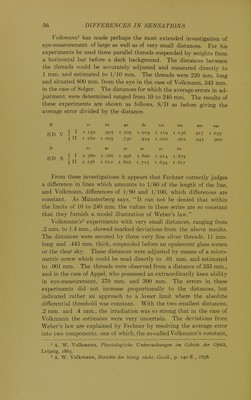
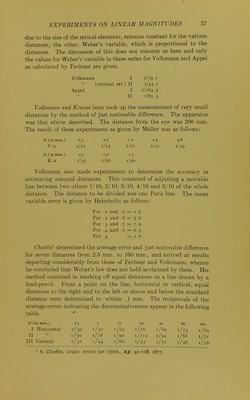
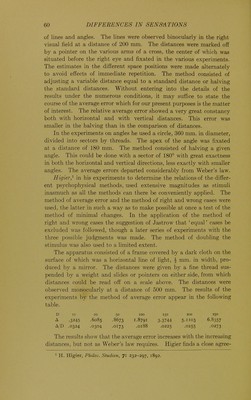
![In the experinaents by the method of just noticeable difference the procedure was the same as in the above experiments except that the variable distance was to be made not equal, but just noticeably greater or 1 less. The results are as follows: D (in mm.) 2.5 5 10 20 40 80 160 I 1/17 1/29 ] '/37 1/53 1/44 . 1/39 1/43 II 1/26 1/32 ] t/45 1/57 1/36 1/32 1/30 The deviations from the results of earlier observations are, accord- ing to Fechner, to be attributed to the method and to the inaccuracies of the hand in measuring off small distances. The method is certainly unsystematic and inferior to that of Volkmann particularly. Miinster- berg, likewise, calls attention to the inaccuracies in measurement where micrometric methods are not employed, especially where the distances are 2.5 and 5 mm. The estimation to hundredths of a millimeter is manifestly impossible with any degree of accuracy. Wundt’s^ experiments to determine the discriminativeness to change of convergence of the eyes have a bearing on the determination of the accuracy of eye-measurement on account of the muscular sensations which accompany eye-movements and fixations. The method of determining this was the following. The subject looked with both eyes through a dark box at a ground-glass surface. Between this surface and the eye was suspended a thread which could be moved to and fro. The displacement necessary in either direction in order that the eye, which was fixated on the thread, could detect it was determined. It was found that the sensitivity to changes in convergence was ap- proximately constant with varying distances, the relative magnitude of the just noticeable displacement of the line of fixation being about 1/51. Miinsterherg^ goes over the whole subject of eye-measurement historically and critically. He calls attention to the various sources of error and the methodological difficulties in such experiments which it is necessary to eliminate and which have not always been guarded against in the earlier investigations. The diverse methods which have been employed and the complicated conditions under which observa- tions have been made make comparisons of results well-nigh im- possible. The psychophysical methods have been, moreover, used in a loose and unsatisfactory manner. He concludes that the question of the relation of the average error to Weber’s law has not been as yet satisfactorily answered. His problem was to isolate the various con- ^ W. Wundt, Beitrdge zur Theorie der Sinneswahrnehmung, Leipzig and Heidelberg, p. 195, 1862. H. Miinsterberg, Beitrage zur experimeniellen Psychologic, Freiburg, ar 125-181, 1889.](https://iiif.wellcomecollection.org/image/b24917059_0060.jp2/full/800%2C/0/default.jpg)