Twenty-sixth report 1997 / Review Body on Doctors' and Dentists' Remuneration ; Chairman, C.B. Gough ; presented to Parliament by the Prime Minister by Command of Her Majesty, February 1997.
- Great Britain. Review Body on Doctors' and Dentists' Remuneration
- Date:
- 1997
Licence: Open Government Licence
Credit: Twenty-sixth report 1997 / Review Body on Doctors' and Dentists' Remuneration ; Chairman, C.B. Gough ; presented to Parliament by the Prime Minister by Command of Her Majesty, February 1997. Source: Wellcome Collection.
47/112 (page 41)
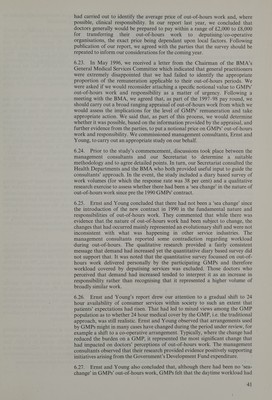
![had carried out to identify the average price of out-of-hours work and, where possible, clinical responsibility. In our report last year, we concluded that doctors generally would be prepared to pay within a range of £2,000 to £8,000 for transferring their out-of-hours work to deputising/co-operative organisations, the exact price being dependant upon local factors. Following publication of our report, we agreed with the parties that the survey should be repeated to inform our considerations for the coming year. 6.23. In May 1996, we received a letter from the Chairman of the BMA’s General Medical Services Committee which indicated that general practitioners were extremely disappointed that we had failed to identify the appropriate proportion of the remuneration applicable to their out-of-hours periods. We were asked if we would reconsider attaching a specific notional value to GMPs’ out-of-hours work and responsibility as a matter of urgency. Following a meeting with the BMA, we agreed that, as part of the 1997-98 pay round, we should carry out a broad ranging appraisal of out-of-hours work from which we would assess the implications for the level of GMPs’ remuneration and take appropriate action. We said that, as part of this process, we would determine whether it was possible, based on the information provided by the appraisal, and further evidence from the parties, to put a notional price on GMPs’ out-of-hours work and responsibility. We commissioned management consultants, Ernst and Young, to carry out an appropriate study on our behalf. 6.24. Prior to the study’s commencement, discussions took place between the management consultants and our Secretariat to determine a suitable methodology and to agree detailed points. In turn, our Secretariat consulted the Health Departments and the BMA who both provided useful input to guide the consultants’ approach. In the event, the study included a diary based survey of work volumes (for which the response rate was 38 per cent) and a qualitative research exercise to assess whether there had been a ‘sea change’ in the nature of out-of-hours work since pre the 1990 GMPs’ contract. 6.25. Ernst and Young concluded that there had not been a ‘sea change’ since the introduction of the new contract in 1990 in the fundamental nature and responsibilities of out-of-hours work. They commented that while there was evidence that the nature of out-of-hours work had been subject to change, the changes that had occurred mainly represented an evolutionary shift and were not inconsistent with what was happening in other service industries. The management consultants reported some contradiction regarding workload during out-of-hours. The qualitative research provided a fairly consistent message that demand had increased yet the quantitative diary based survey did not support that. It was noted that the quantitative survey focussed on out-of- hours work delivered personally by the participating GMPs and therefore workload covered by deputising services was excluded. Those doctors who perceived that demand had increased tended to interpret it as an increase in responsibility rather than recognising that it represented a higher volume of broadly similar work. 6.26. Ernst and Young’s report drew our attention to a gradual shift to 24 hour availability of consumer services within society to such an extent that patients’ expectations had risen. That had led to mixed views among the GMP population as to whether 24 hour medical cover by the GMP, 1.e. the traditional approach, was still realistic. Ernst and Young observed that arrangements used by GMPs might in many cases have changed during the period under review, for example a shift to a co-operative arrangement. Typically, where the change had reduced the burden on a GMP, it represented the most significant change that had impacted on doctors’ perceptions of out-of-hours work. The management consultants observed that their research provided evidence positively supporting initiatives arising from the Government’s Development Fund expenditure. 6.27. Ernst and Young also concluded that, although there had been no ‘sea- change’ in GMPs’ out-of-hours work, GMPs felt that the daytime workload had 4]](https://iiif.wellcomecollection.org/image/b32218424_0047.jp2/full/800%2C/0/default.jpg)