Leishmaniasis : a review of recent literature / by C.M. Wenyon.
- Charles Morley Wenyon
- Date:
- 1922]
Licence: Public Domain Mark
Credit: Leishmaniasis : a review of recent literature / by C.M. Wenyon. Source: Wellcome Collection.
26/36 page 186
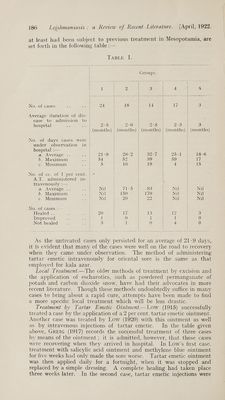
![at least had been subject to previous treatment in Mesopotamia, are set forth in the following table :-— TABLE I. Groups. I | 2 3 4 5 No. of cases 24 18 14 17 3 Average duration of dis- ease to admission to hospital 205 2°6 2B «| 2°3 3 (months) | (months) | (months) | (months) | (months) No. of days cases were | under observation in | hospital :— | ArmA VEL Agee. 2S OS 2 yen ZO 18°6 6b. Maximum 54 52 59 39 U7, c. Minimum 5 16 19 4 15 INO. .O1ncc. Ol leper cent: A.T. administered in- travenously :— a. Average .. Nal 71:5 83 Nil Nil b. Maximum Nil 150 172 Nil Nil ce. Minimum Nil 20 22 Nil Nil No. of cases :— | | | Healed .. a meee o> .() 17 13 | 12 3 Improved oH soa | | 0 | ] | J 0 Not healed we Le 3 | 1 0 4 0 As the untreated cases only persisted for an average of 21-9 days, it is evident that many of the cases were well on the road to recovery when they came under observation. The method of administering tartar emetic intravenously for oriental sore is the same as that employed for kala azar. Local Treatment.—The older methods of treatment by excision and the application of escharotics, such as powdered permanganate of potash and carbon dioxide snow, have had their advocates in more recent literature. Though these methods undoubtedly suffice in many cases to bring about a rapid cure, attempts have been made to find a more specific local treatment which will be less drastic. Treatment by Tartar Emetic Ointment—lLow (1915) successfully treated a case by the application of a 2 per cent. tartar emetic ointment. Another case was treated by Low (1920) with this ointment as well as by intravenous injections of tartar emetic. In the table given above, GREIG (1917) records the successful treatment of three cases by means of the ointment; it is admitted, however, that these cases were recovering when they arrived in hospital. In Low’s first case, treatment with salicylic acid ointment and methylene blue ointment for five weeks had only made the sore worse. Tartar emetic ointment was then applied daily for a fortnight, when it was stopped and replaced by a simple dressing. A complete healing had taken place three weeks later. In the second case, tartar emetic injections were](https://iiif.wellcomecollection.org/image/b33437993_0026.jp2/full/800%2C/0/default.jpg)
 No text description is available for this image
 No text description is available for this image
 No text description is available for this image