Volume 1
A system of anatomical plates of the human body : accompanied with descriptions, and physiological, pathological & surgical observations / [by] John Lizars.
- John Lizars
- Date:
- 1823-1826
Licence: Public Domain Mark
Credit: A system of anatomical plates of the human body : accompanied with descriptions, and physiological, pathological & surgical observations / [by] John Lizars. Source: Wellcome Collection.
Provider: This material has been provided by King’s College London. The original may be consulted at King’s College London.
139/480 (page 119)
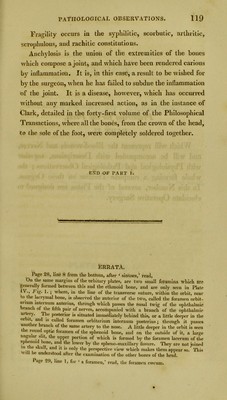
![Fragility occurs in the syphilitic, scorbutic, arthritic, scrophulous, and rachitic constitutions. Anchylosis is the union of the extremities of the bones which compose a joint, and which have been rendered carious by inflammation. It is, in this case, a result to be wished for by the surgeon, when he has failed to subdue the inflammation of the joint. It is a disease, however, which has occurred without any marked increased action, as in the instance of Clark, detailed in the forty-first volume of the Philosophical Transactions, where all the bones, from the crown of the head, to the sole of the foot, were completely soldered together. EttD OF PART I. Brrata. Page 28, line 8 from the bottom, after ‘ sinuses,’ read, On the same margins of the orbitary plates, are two small foramina which are generally formed between this and the ethmoid bone, and are only seen in Plate IV., 1< ig. 1. ; where, in the line of the transverse suture, within the orbit, near to the lacrymal bone, is observed the anterior of the two, called the foramen orbit- anum internum anterius, through which passes the nasal twig of the ophthalmic branch ot the fifth pair of nerves, accompanied with a branch of the ophthalmic artery. The posterior is situated immediately behind this, or a little deeper in the oi it, ami is called foramen orbitarium internum posterius ; through it passes anot ler ranch of the same artery to the nose. A little deeper in the orbit is seen t le roun optic foramen of the sphenoid bone, and on the outside of it, a large an u ar s it, the upper portion of which is formed by the foramen lacerum of the sp icnoii lone, and the lower by the spheno-maxillary fissure. They are not joined in t ie s ul , and it is only the perspective view which makes them appear so. This u-)]| be understood after the examination of the other bones of the head. Page 29, line 1, for ‘ a foramen,’ read, the foramen coecum.](https://iiif.wellcomecollection.org/image/b21305365_0001_0139.jp2/full/800%2C/0/default.jpg)