Familiar lectures on botany, practical, elementary, and physiological : with an appendix containing descriptions of the plants of the United States and exotics, &c., for the use of seminaries and private students / by Almira H. Lincoln.
- Almira Hart Lincoln Phelps
- Date:
- 1836
Licence: Public Domain Mark
Credit: Familiar lectures on botany, practical, elementary, and physiological : with an appendix containing descriptions of the plants of the United States and exotics, &c., for the use of seminaries and private students / by Almira H. Lincoln. Source: Wellcome Collection.
Provider: This material has been provided by the National Library of Medicine (U.S.), through the Medical Heritage Library. The original may be consulted at the National Library of Medicine (U.S.)
16/432
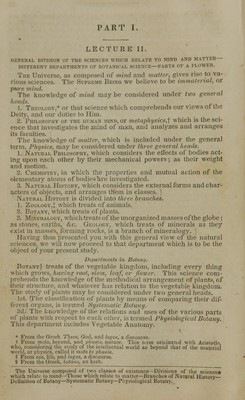
![PART I LECTURE II. GENERAL DIVISION OF THE SCIENCES WHICH RELATE TO MIND AND MATTER DIFFERENT DEPARTMENTS OF BOTANICAL SCIENCE—PARTS OF A FLOWER. The Universe, as composed of mind and matter, gives rise to va- rious sciences. The Supreme Being we believe to be immaterial, or pure mind. The knowledge of mind maybe considered under two general heads. 1. Theology,* or that science which comprehends our views of the Deity, and our duties to Him. 2. Philosophy of the human mind, or metaphysics,^ which is the sci- ence that investigates the mind of man, and analyzes and arranges its faculties. The knowledge of matter, which is included under the general term, Physics, may be considered under three general heads. 1. Natural Philosophy, which considers the effects of bodies act- ing upon each other by their mechanical powers; as their weight and motion. 2. Chemistky, in which the properties and mutual action of the elementary atoms of bodies are investigated. 3. Natural History, which consider^ the external forms and char- acters of objects, and arranges th'em in classes. \ Natural History is divided into three branches. 1. Zoology,! which treats of animals. 2. Botany, which treats of plants. 3. Mineralogy, which treats of the unorganized masses of the globe; as stones, earths, &c. Geology, which treats of minerals as they exist in masses, forming rocks, is a branch of mineralogy. Having thus presented you with this general view of the natural sciences, we will now proceed to that department which is to be the object of your present study. Departments in Botany. Botany§ treats of the vegetable kingdom, including every thing which grows, having root, stem, leaf, or flower. This science com- prehends the knowledge of the methodical arrangement of plants, of their structure, and whatever has relation to the vegetable kingdom. The study of plants may be considered under two genera] heads. 1st. The classification of plants by means of comparing their dif- ferent organs, is termed Systematic Botany. 2d. The knowledge of the relations and uses of the various parts of plants with respect to each other, is termed Physiological Botany. This department includes Vegetable Anatomy. » * From the Greek Theos, God, and logos, a discourse. t From mda, beyond, and pkusis, nature. This term oripinand with Aristotle, who, considering the study of the intellectual world as beyond that of the material world, or physics, called it metata pkusis. t From zoe, life, and logos, a discourse. § From the Greek, botane, an herb. The Universe composed of two classes of existence-Divisions of the sciences which relate to mind—Those which relate to matter—Branches of Natural History Definition of Botany—Systematic Botany—Physiological Botany.](https://iiif.wellcomecollection.org/image/b21147267_0016.jp2/full/800%2C/0/default.jpg)