Nitro-, arylazo-, and amino-glyoxalines / by Robert George Fargher and Frank Lee Pyman.
- Fargher, Robert George.
- Date:
- [1919?]
Licence: In copyright
Credit: Nitro-, arylazo-, and amino-glyoxalines / by Robert George Fargher and Frank Lee Pyman. Source: Wellcome Collection.
28/44 page 244
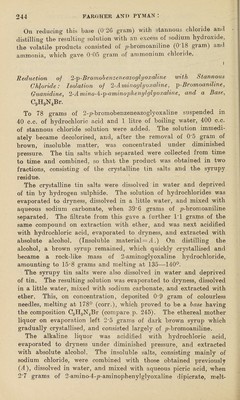
![On reducing this base (0'26 gram) with stannous chloride and distilling the resulting solution with an excess of sodium hydroxide, the volatile products consisted of p-bromoaniline (0‘18 gram) and ammonia, which gave 0*05 gram of ammonium chloride. } Reduction of 2-p - Br o m o b e n zeneaz o glyoxalin e with Stannous Chloride : Isolation of 2-Aminoglyuxaline, p-Bromoaniline, Guanidine, 2-Amino-^-^-amino'phenylglyoxaline, and a Base, C9H9N4Br. To 78 grams of 2-p-bromobenzeneazoglyoxaline suspended in 40 c.c. of hydrochloric acid and 1 litre of boiling water, 400 c.c. of stannous chloride solution were added. The solution immedi¬ ately became decolorised, and, after the removal of 0‘5 gram of brown, insoluble matter, was concentrated under diminished pressure. The tin salts which separated were collected from time to time and combined, so that the product was obtained in two1 fractions, consisting of the crystalline tin salts and the syrupy residue. The crystalline tin salts were dissolved' in water and deprived of tin by hydrogen sulphide. The solution of hydrochlorides was evaporated to dryness, dissolved in a little water, and mixed with aqueous sodium carbonate, when 39'6 grams of ^7-bromoaniline separated. The filtrate from this gave a further IT grams of the same compound on extraction with ether, and was next acidified with hydrochloric acid, evaporated to dryness, and extracted with absolute alcohol. (Insoluble material — A.) On distilling the alcohol, a brown syrup remained, which quickly crystallised and became a rock-like mass of 2-aminoglyoxaline hydrochloride, amounting to 15 *8 grams and melting at 135—140°. The syrupy tin salts were also dissolved in water and deprived of tin. The resulting solution was evaporated to dryness, dissolved in a little water, mixed with sodium carbonate, and extracted with ether. This, on concentration, deposited 0-9 gram of colourless needles, melting at 178° (corr.), which proved to be a base having the composition C9H9N4Br (compare p. 245). The ethereal mother liquor on evaporation left 2-5 grams of dark brown syrup which gradually crystallised, and consisted largely of p-bromoaniline. The alkaline liquor was acidified with hydrochloric acid, evaporated to dryness under diminished pressure, and extracted with absolute alcohol. The insoluble salts, consisting mainly of sodium chloride, were combined with those obtained previously (T), dissolved in water, and mixed with aqueous picric acid, when 2'7 grams of 2-amino-4-^7-aminopheny]glyoxaline dipicrate, melt-](https://iiif.wellcomecollection.org/image/b30622062_0028.jp2/full/800%2C/0/default.jpg)
 No text description is available for this image
 No text description is available for this image
 No text description is available for this image