Nitro-, arylazo-, and amino-glyoxalines / by Robert George Fargher and Frank Lee Pyman.
- Fargher, Robert George.
- Date:
- [1919?]
Licence: In copyright
Credit: Nitro-, arylazo-, and amino-glyoxalines / by Robert George Fargher and Frank Lee Pyman. Source: Wellcome Collection.
1/44
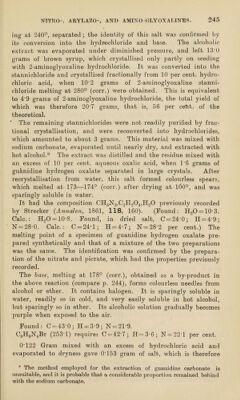
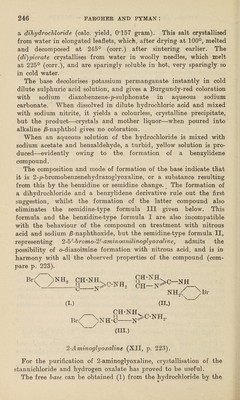
![XXyi.-Nitro-, Arylazoand Amino-glyoxalines. By Robert George Fargiier and Frank Lee Pyman. This investigation was begun witb the object of effecting the synthesis of purine derivatives by a method complementary to those which have been employed hitherto. In these, the pyrimidine nucleus is first built up and the glyoxaline ring closed subsequently. We proposed to prepare 4-aminoglyoxaline-5-carb- oxylic acid,* condense it with cyanic acid, and eliminate water with the production of xanthine* co2h-c*nh NH2 COM i 2 i CO O-NH i m NH—0—N >CH NH-CO GO C-NH i u hH-O-N Such a synthesis would be of interest in view of the suggestion that purine derivatives originate from histidine in the animal body (compare Hopkins, T., 1916, 109, 629). Although the starting material for the proposed synthesis, 4-aminoglyoxaline-5-carboxylic acid, was unknown, we did not anticipate that its preparation would offer any serious difficulty. We have, however, so far failed to obtain this substance, and now give an account of our attempts to prepare this and other amino- substituted glyoxalines. An account of the investigation may be subdivided under three headings: first, the preparation of the glyoxalines and their carb¬ oxylic acids, which were required as starting materials; second, the preparation and properties of nitroglyoxalines; and last, the preparation and properties of arylazoglyoxalines. (1) The Preparation of Glyoxalines and their Carboxylic Acids. —For the purpose of this investigation, it was necessary to prepare considerable quantities of glyoxaline-4:5-dicarboxylic acid, the most convenient source of glyoxaline. This acid was first prepared by Maquenne (Ann. chim. phys., 1891, [vi], 24, 525), by mixing aqueous solutions of nitrotartaric acid and hexamethylenetetramine, adding ammonia, and allowing the mixture to become hot, and sub¬ sequently by Dedichen (Ber., 1906, 39, 1835), who replaced the hexamethylenetetramine by formaldehyde. We have carried out a large number of experiments on the best conditions for the pre- * In glyoxalines containing a free imino-group, the 4- and 5-positions are equivalent.](https://iiif.wellcomecollection.org/image/b30622062_0001.jp2/full/800%2C/0/default.jpg)