Handbook of the polariscope and its pracitcal applications / adapted from the German editon of H. Landolt, by D.C. Robb and V.H. Veley.
- Hans Heinrich Landolt
- Date:
- 1882
Licence: Public Domain Mark
Credit: Handbook of the polariscope and its pracitcal applications / adapted from the German editon of H. Landolt, by D.C. Robb and V.H. Veley. Source: Wellcome Collection.
35/320 (page 15)
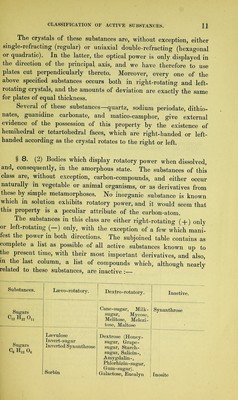
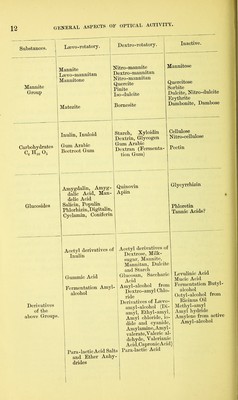
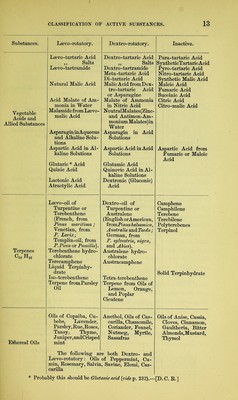
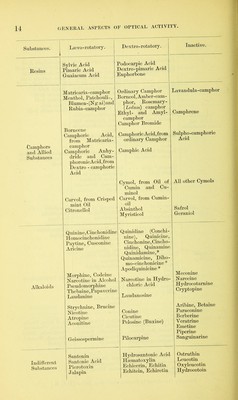
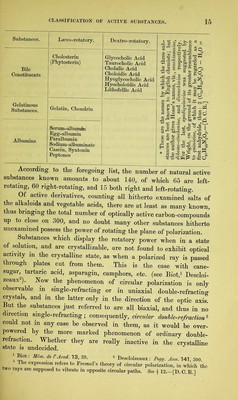
![Substances. Laevo-rotatory. Dextro-rotatory. Cholesterin (Phytosterin) Glycocholic Acid % J ;§ Taurocholic Acid S Cholalic Acid J2 § Choloidic Acid ^ ° ~ Bile Constituents Lithofellic Acid Hyocholoidic Acid ^ T n fiTi rrfWl 11 A^ 5 ^ G-elatinous Substances. Gelatin, Chondrin Albumins Serum- albumin Egg-albumin Paralbumin Sodium-albuminate Casein, Syntonin Peptones According to the foregoing list, the number of natural active substances known amounts to about 140, of which 65 are left- rotating, 60 right-rotating, and 15 both right and left-rotating. Of active derivatives, counting all hitherto examined salts of the alkaloids and vegetable acids, there are at least as many known, thus bringing the total number of optically active carbon-compounds up to close on 300, and no doubt many other substances hitherto unexamined possess the power of rotating the plane of polarization. Substances which display the rotatory power when in a state of solution, and are crystallizable, are not found to exhibit optical activity in the crystalline state, as when a polarized ray is passed through plates cut from them. This is the case with cane- sugar, tartaric acid, asparagin, camphors, etc. (see Biot,1 Descloi- zeaux2). Now the phenomenon of circular polarization is only observable in single-refracting or in uniaxial double-refracting crystals, and m the latter only in the direction of the optic axis. But the substances just referred to are all biaxial, and thus in no direction single-refracting; consequently, circular double-refraction3 could not in any case be observed in them, as it would be over- powered by the more marked phenomenon of ordinary double- refraction. Whether they are really inactive in the crystalline state is undecided. 3 Si?* ‘ Mem‘ de V Acad- 13> 39- 3 Descloizeaux : Fogg. Ann. 141, 300 The expression refers to Fresnel’s theory of circular polarization, in which the two rays are supposed to vibrate in opposite circular paths. See § 12.—[D. C. R]](https://iiif.wellcomecollection.org/image/b28125952_0035.jp2/full/800%2C/0/default.jpg)