Handbook of the polariscope and its pracitcal applications / adapted from the German editon of H. Landolt, by D.C. Robb and V.H. Veley.
- Hans Heinrich Landolt
- Date:
- 1882
Licence: Public Domain Mark
Credit: Handbook of the polariscope and its pracitcal applications / adapted from the German editon of H. Landolt, by D.C. Robb and V.H. Veley. Source: Wellcome Collection.
36/320 (page 16)
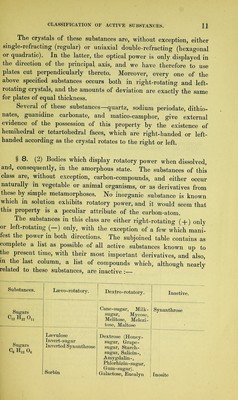
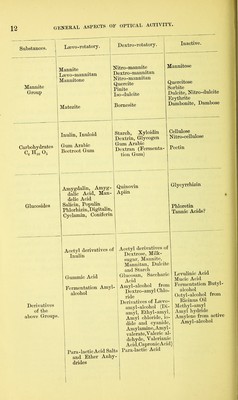
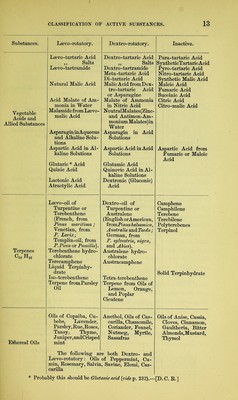
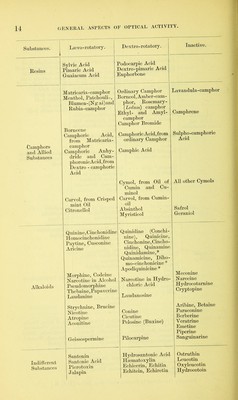
![But when these substances are brought into the amorphous solid form their optical activity is retained—a fact first observed by Biot with cast plates of sugar and tartaric acid.1 § 9. As a third and distinct class are regarded those substances which are known to exhibit rotatory power both in the crystalline state and in solution. At present only two such substances are known, viz., strychnine sulphate crystallizing with water in quad- rate octahedra,3 and regular amylamine-alum.3 B. Nature of Rotatory Power. § 10. The fact that substances in the first of the above classes manifest rotatory power only in the crystalline state and lose it directly they are brought into solution, is proof that the rotation is dependent on crystalline structure—that is, upon a particular arrangement in the groups of molecules (forming the crystal). Dissolution or fusion breaks up this arrangement, and the optical power is consequently lost. In this case then the phenomenon is purely physical. The second class of substances, on the contrary, exhibit rotatory power in the liquid state. Now there is every reason to believe of matter in this form that the smallest quantities, capable oi independent motion as units consist, not of individual molecm.es, but of groups, and it may therefore be conjectured that the solution of a solid in a liquid does not entail a complete separation of the molecules from each other, but that they still exist in composite groups4 Whenever, therefore, we find liquids exhibiting rotatory power, we might assume that, as in the case of crystals the cause lies in the mode in which the molecules group themselves. Thus again the phenomenon would he purely physical. But for this supposition to be correct the rotatory pro- perties of active substances should vanish when these group- ings are reallv broken up—that is, when the substances are broug into the norma ! gaseous state. This important point was first investigated by Biot,5 in 1817. He filled a tin tube, fitted at both 1 Biot: Mem. de VAcad. 13, 126. Ann. Chim. Phys. [3] 10, 175; 28, 351. 2 Descloizeaux : Fogg. Ann. 102, 474. 3 Le Bel: Ber. d. deutsch. chem. Gesell. 5, 391. . 4 See, on this point, Naumann: Ueber MoleculverHndunrjen nach festen Verhaltnmen. Heidelberg, 1872, pp. 37 49. 5 Biot: Mem de VAcad. 2, 114.](https://iiif.wellcomecollection.org/image/b28125952_0036.jp2/full/800%2C/0/default.jpg)