Handbook of the polariscope and its pracitcal applications / adapted from the German editon of H. Landolt, by D.C. Robb and V.H. Veley.
- Hans Heinrich Landolt
- Date:
- 1882
Licence: Public Domain Mark
Credit: Handbook of the polariscope and its pracitcal applications / adapted from the German editon of H. Landolt, by D.C. Robb and V.H. Veley. Source: Wellcome Collection.
65/320 (page 45)
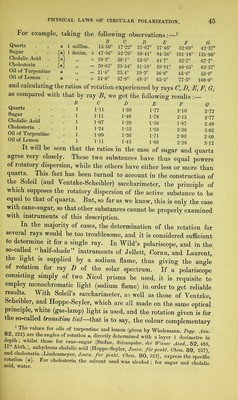
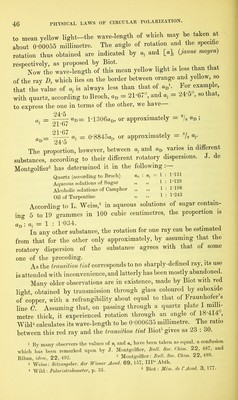
![For example, taking the following observations:—1 Quartz Sugar Cholalic Acid Cholesterin Oil of Turpeni Oil of Lemon 1 millim. B C ID F F G . a 15-50° 17-22° 21-67° 27-46° 32-69° 42-37° • H 1 decim. + 47-56° 52-70° 66-41° 84-56° 101-18° 131-96° [a] „ + 28-2° 30-1° 33-9° 44-7° 52-7° 67-7° [«] 5 > 20-63° 25-54° 31-59° 39-91° 48-65° 62-37° ie a 5 5 21-5° 23.4° 29-3° 36-8° 43-6° 55-9° a n + 34-0° 37-9° 48-5° 63-3° 77-5° 106-0° W11U me ruuos oi rotation experienced by rays U, JJ, as compared with that by ray B, we get the following results Quartz Sugar Cholalic Acid Cholesterin . Oil of Turpentine Oil of Lemon C F F F G 1-11 1-39 1-77 2-10 2-72 1-11 1-40 1-78 2-13 2-77 1-07 1-20 1-59 1-87 2.40 1-24 1-53 1-93 2-36 302 1-09 1-36 1-71 2-03 2-60 1-11 1-43 1-86 2-28 3-12 s ratios in the case of sugar and quartz »■ ~ Aiicoe two suubtances nave tnus equal powers of rotatory dispersion, while the others have either less or more than quartz. This, fact has been turned to account in the construction of the Soleil (and Yentzke-Scheibler) saccharimeter, the principle of which supposes the rotatory dispersion of the active substance to be equal to that of quartz. But, so far as we know, this is only the case with cane-sugar, so that other substances cannot be properly examined with instruments of this description. In the majority of cases, the determination of the rotation for several rays would be too troublesome, and it is considered sufficient to determine it for a single ray. In Wild’s polariscope, and in the so-called “half-shade” instruments of Jellett, Cornu, and Laurent, the light is supplied by a sodium flame, thus giving the angle of rotation for ray D of the solar spectrum. If a polariscope consisting simply of two Nicol prisms be used, it is requisite to employ monochromatic light (sodium flame) in order to get reliable results. With Soleil’s saccharimeter, as well as those of Yentzke, Scheibler, and Hoppe-Seyler, which are all made on the same optical principle, white (gas-lamp) light is used, and the rotation given is for the so-called transition tint—that is to say, the colour complementary qo VaLf8 ^ °ilS °f turPentine and iemon (given by Wiedemann, Fogg. Ann. 222) are the angles of rotation a, directly determined with a layer 1 decimetre in ttS at! 7MSt th°Se f°r cane-su8'ar (Stefan, Sitzungsber. der Wiener Acad., 52, 486, 11 Abth.), anhydrous cholalic acid (Hoppe-Seyler, Journ. furprakt. Chem. 89, 257) and cholesterin uLmdenmeyer, Journ. fur prakt. Chem. 90, 323), express the specific rotation [a]. For cholesterin the solvent used was alcohol; for sugar and cholalic acid, water.](https://iiif.wellcomecollection.org/image/b28125952_0065.jp2/full/800%2C/0/default.jpg)