Handbook of the polariscope and its pracitcal applications / adapted from the German editon of H. Landolt, by D.C. Robb and V.H. Veley.
- Hans Heinrich Landolt
- Date:
- 1882
Licence: Public Domain Mark
Credit: Handbook of the polariscope and its pracitcal applications / adapted from the German editon of H. Landolt, by D.C. Robb and V.H. Veley. Source: Wellcome Collection.
74/320 (page 54)
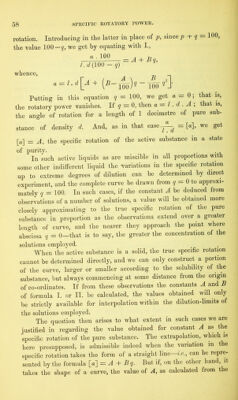
![equal length the angles of rotation were in direct proportion to the amounts of sugar in solution, so that the value for [a] was constant whatever the degree, of concentration of the solution. The same result was obtained with mixtures of oil of turpentine and et er. Biot therefore assumed that the amount of deviation is simply propor- tional to the number of optically active molecules encountered by the ray in its passage through the solution, and thence formulated the following axiom:— . . - “ When an optically active substance is dissolved in an inactive liquid, which exerts no influence upon it chemically, the deviation is in direct proportion to the quantity of active substance m the unit- volume of solution, and thus specific rotation [a] is determinable from the equation [a] = l.t.d (See § 21.) Subsequently (1838), from experiments with aqueous solutions of tartaric acid, Biot1 found that the specific rotation of this substance increases in proportion as the solutions are more dilute This was long regarded as an exceptional case, until (in 1852) Biot with the aid of improved polariscopic apparatus, found that similar phenomena are exhibited by other substances. Alcoholic and acetic solutions o camphor, for example, were found to show a decrease of specific rotation in proportion to the diluteness of the solutions. With oil of turpentine, on the contrary, an increase was observed, on th addition of successive quantities of aicohol or olive-ofl; andi lastly, even in the case of sugar, a feeble increase with the amount of water the solution could be detected. Moreover, the influence of the nature of the solvent medium was brought to light, as l was oun different values of [a] for camphor were obtained, according as solut was effected in alcohol or in equal weights of acetic acid. 1 e Biot concluded generally that the values of specific rotation deduced from solutions are more or less variable ; so t at le p ellom cannot, as at one time, be regarded as the result of mere mechanical diffusion of active molecules in an optically indifferent medium This fuller and more correct view of specific rotation has ever, remained in a great measure unheeded The fact that solutions of cane-sugar the angle of rotation is almost exactly propor- tional to the degree of concentration, so that the saccharine s reng of a solution can be deduced from the deviation observed therein, has tru. Jo V A rad. 15, 93 ; Ann. Chim. Phys. [3], 10, 385.](https://iiif.wellcomecollection.org/image/b28125952_0074.jp2/full/800%2C/0/default.jpg)