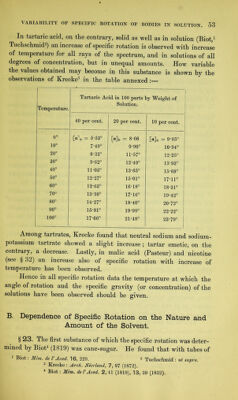
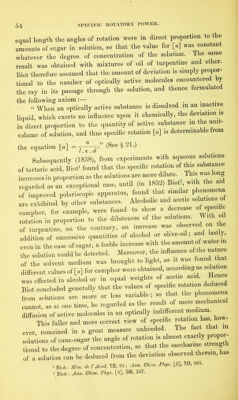
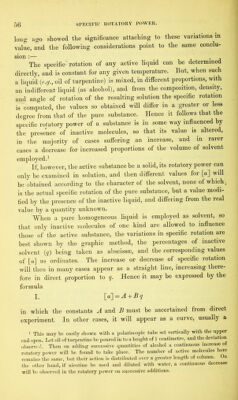
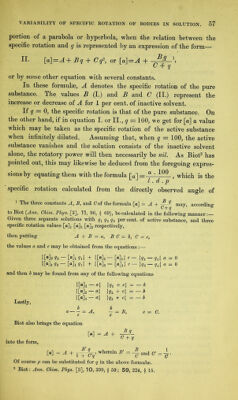
Handbook of the polariscope and its pracitcal applications / adapted from the German editon of H. Landolt, by D.C. Robb and V.H. Veley.
- Hans Heinrich Landolt
- Date:
- 1882
Licence: Public Domain Mark
Credit: Handbook of the polariscope and its pracitcal applications / adapted from the German editon of H. Landolt, by D.C. Robb and V.H. Veley. Source: Wellcome Collection.
75/320 (page 55)
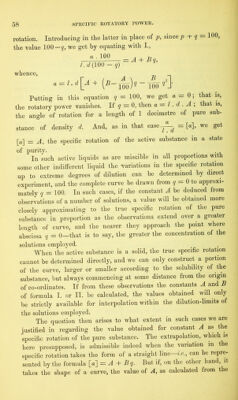
![led to the construction of the optical saccharimeter, which has been extensively adopted and employed in the analysis of other substances besides sugar. Notwithstanding that Biot,1 in 1860, in a com- prehensive paper containing a resume of all his previous researches in connection with the subject, again called attention to the facts of the case, the belief is still prevalent that all optically active substances behave essentially like sugar, and that the optical analysis of a sub- stance is complete when the deviation caused by any solution of it has been observed, and the specific rotation calculated therefrom by the formulae M = . 100 or = 100 l d. p l. c the resulting value being regarded as constant.2 In this manner the specific rotations of a very large number of substances have been calculated, and still appear in chemical and physical text-books with- out reference to the concentration or nature of the solvent media employed. A few years ago, Oudemans, jun.,3 contributed fresh proofs that the specific rotation of substances is susceptible of considerable varia- tions, according as different inactive liquids are employed for solution. Since then, Hesse,4 in 1875, published a large number of determina- tions of rotatory power, extending over fifty different active solid substances in solutions of different degrees of concentration. Even for small differences (between 1 and 10 grammes of substance in 100 cubic centimetres of solution), nearly all these substances displaved appreciable variations in the amount of their specific rotation, and nearly always a decrease for increased proportion of active substance. Still greater differences, in some instances exceeding 50°, resulted from the use of different solvents. § 24. Observations like those of Hesse have thus shown con- clusively that, as a rule, no value can be attached to specific rotations deduced from an isolated observation of an individual solution. Biot,5 however, in his investigations of the rotatory power of tartaric acid 1 Biot: Ann. Chim. Phys. [3], 59, 206. 2 See, by way of illustration, Buff, Kopp, and Zamminer’s Lehr buck d. phys. u. theoret. Chem., p. 387. 3 Oudemans : Pogg. Ann. 148, 337; Liebig's Ann. 166, 65. 4 Hesse : Liebig's Ann. 176, 89, 189. 5 Biot: Mem. de VAcad. 15, 205 (1838); 16, 254; Ann. Chim. Phys. f31, 10, 385 • 28, 215; 36, 257; 59, 219.](https://iiif.wellcomecollection.org/image/b28125952_0075.jp2/full/800%2C/0/default.jpg)