Handbook of the polariscope and its pracitcal applications / adapted from the German editon of H. Landolt, by D.C. Robb and V.H. Veley.
- Hans Heinrich Landolt
- Date:
- 1882
Licence: Public Domain Mark
Credit: Handbook of the polariscope and its pracitcal applications / adapted from the German editon of H. Landolt, by D.C. Robb and V.H. Veley. Source: Wellcome Collection.
76/320 (page 56)
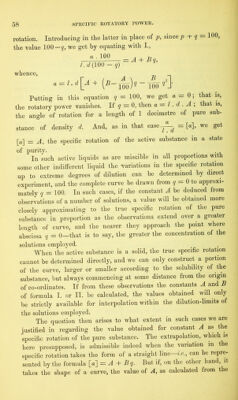
![long ago showed the significance attaching to these variations in value, and the following considerations point to the same conolu- sion :— The specific rotation of any active liquid can be determined directly, and is constant for any given temperature. But, when such a liquid {e.g., oil of turpentine) is mixed, in different proportions, with an indifferent liquid (as alcohol), and from the composition, density, and angle of rotation of the resulting solution the specific rotation is computed, the values so obtained will differ in a greater or less degree from that of the pure substance. Hence it follows that the specific rotatory power of a substance is in some way influenced by the presence of inactive molecules, so that its value is altered, in the majority of cases suffering an increase, and in rarer cases a decrease for increased proportions of the volume of solvent employed.1 If, however, the active substance be a solid, its rotatory power can only be examined in solution, and then different values for [a] will be obtained according to the character of the solvent, none of which# is the actual specific rotation of the pure substance, but a value modi- fied by the presence of the inactive liquid, and differing from the real value by a quantity unknown. When a pure homogeneous liquid is employed as solvent, so that only inactive molecules of one kind are allowed to influence those of the active substance, the variations in specific rotation are best shown by the graphic method, the percentages of inactive solvent (q) being taken as abscissae, and the corresponding values of [a] as ordinates. The increase or decrease of specific rotation will then in many cases appear as a straight line, increasing there- fore in direct proportion to q. Hence it may be expressed by the formula I. [a]=H+^g in which the constants A and B must be ascertained from direct experiment. In other cases, it will appear as a curve, usually a 1 This may be easily shown with a polariscopic tube set vertically with the upper end open. Let oil of turpentine be poured in to a height of 1 centimetre, and the deviation observt d. Then on adding successive quantities of alcohol a continuous increase of rotatory power will be found to take place. The number of active molecules here remains the same, but their action is distributed over a greater length of column. On the other hand, if nicotine be used and diluted with water, a continuous decrease will be observed in the rotatory power on successive additions.](https://iiif.wellcomecollection.org/image/b28125952_0076.jp2/full/800%2C/0/default.jpg)