Handbook of the polariscope and its pracitcal applications / adapted from the German editon of H. Landolt, by D.C. Robb and V.H. Veley.
- Hans Heinrich Landolt
- Date:
- 1882
Licence: Public Domain Mark
Credit: Handbook of the polariscope and its pracitcal applications / adapted from the German editon of H. Landolt, by D.C. Robb and V.H. Veley. Source: Wellcome Collection.
77/320 (page 57)
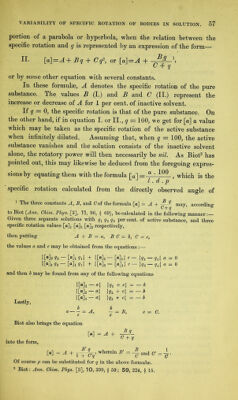
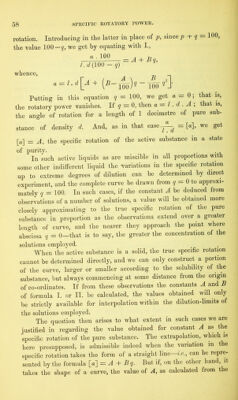
![portion of a parabola or hyperbola, when -the relation between the specific rotation and q is represented by an expression of the form— II. [a] = A+ Bq + Off, or \a\=A + AAl, C -f q or by some other equation with several constants. In these formulae, A denotes the specific rotation of the pure substance. The values B (I.) and B and C (II.) represent the increase or decrease of A for 1 per cent, of inactive solvent. If 9 — 0, the specific rotation is that of the pure substance. On the other hand, if in equation I. or II., q — 100, we get for [a] a value which may be taken as the specific rotation of the active substance when infinitely diluted. Assuming that, when q = 100, the active substance vanishes and the solution consists of the inactive solvent alone, the rotatory power will then necessarily be nil. As Biot2 has pointed out, this may likewise be deduced from the foregoing expres- sions by equating them with the formula |~a~|= a ' , which is the L J l . d . p specific rotation calculated from the directly observed angle of The three constants A, B, and C of the formula = A + ——^ may, according’ to Biot [Ann. Chim. Phys. [3], 11, 96, § 69), be calculated in the following manner:— G-iven three separate solutions with q1 q2 q?j per cent, of active substance, and three specific rotation values [a]: [a]2 [a]3 respectively, then putting A + B = a, B C = b, C = e, the values a and c may be obtained from the equations :— I M2 ?2 — Ml £if + |.Oh — Mil C — \q2 — qi \ a = 0 I Ms ?3 — Mi 2i I + I Ms ~ Mi} e — | q3 — q11 a = 0 and then b may be found from any of the following equations Lastly, ) Mi — «| tei + e\ = — b I Ms — «} \q% + c\ = — b I Ms — a\ I ft + c\ =? — b Biot also brings the equation into the form, M A + G + q [a]= A + YApW Wherein * = 4 and & | ~ • Of course p can be substituted for q in the above formulge. 2 Biot: Ann. Chim. Phys. [3], 10, 399, § 59; 59, 224, § 15.](https://iiif.wellcomecollection.org/image/b28125952_0077.jp2/full/800%2C/0/default.jpg)