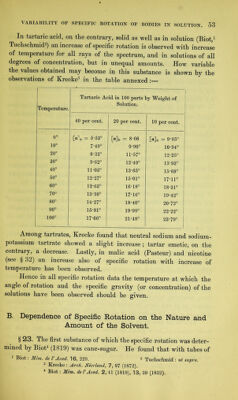
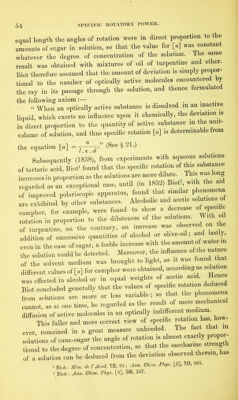
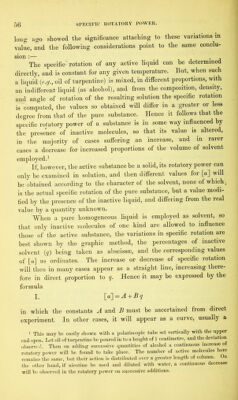
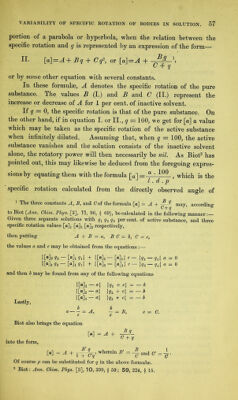
Handbook of the polariscope and its pracitcal applications / adapted from the German editon of H. Landolt, by D.C. Robb and V.H. Veley.
- Hans Heinrich Landolt
- Date:
- 1882
Licence: Public Domain Mark
Credit: Handbook of the polariscope and its pracitcal applications / adapted from the German editon of H. Landolt, by D.C. Robb and V.H. Veley. Source: Wellcome Collection.
78/320 (page 58)
![rotation. Introducing in the latter in place of p, since p + q - 100, the value 100 — q, we get by equating with I., _ o^lOO A B /.d(100-?) whence, a = l.d\A + (-B-^)?-ToO Putting in this equation q = 100, we get a = 0 ; that is, the rotatory power vanishes. If a = 0, then a — l . d . A; that is, the angle of rotation for a length of 1 decimetre of pure sub- stance of density d. And, as in that case-—- = [a], we ■} get [a] - A, the specific rotation of the active substance in a state of purity. . In such active liquids as are miscible in all proportions with some other indifferent liquid the variations in the specific rotation up to extreme degrees of dilution can he determined by direct experiment, and the complete curve be drawn from q = 0 to approxi- mately q = 100. In such cases, if the constant A be deduced from observations of a number of solutions, a value will be obtained more closely approximating to the true specific rotation of the pure substance in proportion as the observations extend over a greater length of curve, and the nearer they approach the point where abscissa q = 0—that is to say, the greater the concentration of the solutions employed. When the active substance is a solid, the -true specific rotation cannot be determined directly, and we can only construct a portion of' the curve, larger or smaller according to the solubility of the substance, but always commencing at some distance from the origin of co-ordinates. If from these observations the constants A and B of formula I. or II. be calculated, the values obtained will only be strictly available for interpolation within the dilution-limits of the solutions employed. The question then arises to what extent in such cases we are justified in regarding the value obtained for constant A as the specific rotation of the pure substance. The extrapolation, which is here presupposed, is admissible indeed when the variation in the specific rotation takes the form of a straight line—ie., can be repre- sented by the formula [a] = A + B q. But if, on the other hand, it takes the shape of a curve, the value of A, as calculated from the](https://iiif.wellcomecollection.org/image/b28125952_0078.jp2/full/800%2C/0/default.jpg)