Handbook of the polariscope and its pracitcal applications / adapted from the German editon of H. Landolt, by D.C. Robb and V.H. Veley.
- Hans Heinrich Landolt
- Date:
- 1882
Licence: Public Domain Mark
Credit: Handbook of the polariscope and its pracitcal applications / adapted from the German editon of H. Landolt, by D.C. Robb and V.H. Veley. Source: Wellcome Collection.
82/320 (page 62)
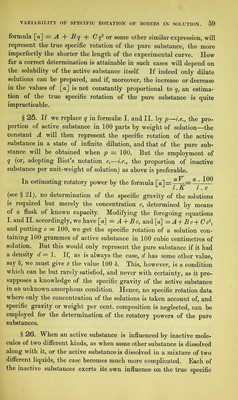
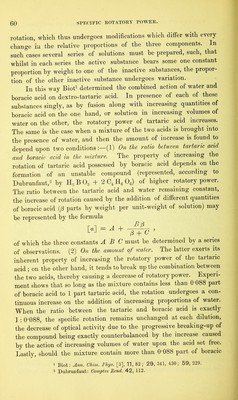
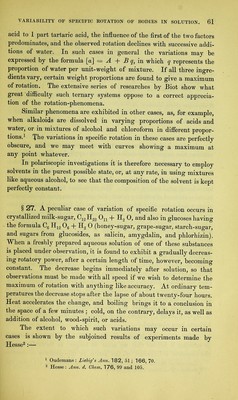
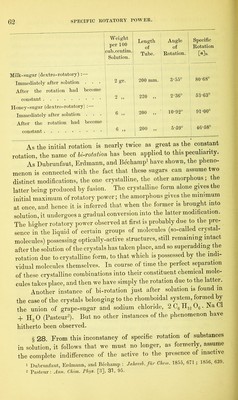
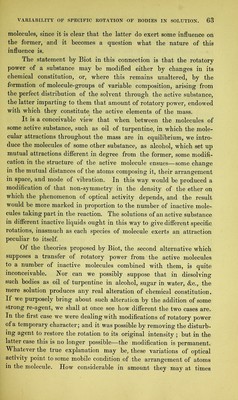
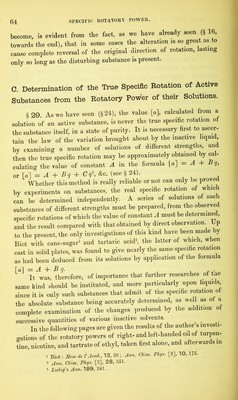
![Weight per 100 cub.centim. Solution. Length of : Tube. Angle of Rotation. Specific Rotation [<*]d. Milk-sugar (dextro-rotatory) :— Immediately after solution . • • 2 gr. 200 mm. 3-55° 80-68° After the rotation had become 2 „ 220 ,, 2-36° 1 53-63° Honey-sugar (dextro-rotatory) Immediately after solution . . . 6 „ 200 „ 10-92° 91-00° 1 After the rotation had become constant 1 6 ,, 200 „ 5-59° 1 46-58° j\.s tne milieu ruttitiuii io — 0 t rotation, the name of bi-rotation has been applied to this peculiarity. As Dubrunfaut, Erdmann, and Bechamp1 have shown, the pheno- menon is connected with the fact that these sugars can assume two distinct modifications, the one crystalline, the other amorphous ; the latter being produced by fusion. The crystalline form alone gives the initial maximum of rotatory power; the amorphous gives the minimum at once, and hence it is inferred that when the former is brought into solution, it undergoes a gradual conversion into the latter modification. The higher rotatory power observed at first is probably due to the pre- sence in the liquid of certain groups of molecules (so-called crystal- molecules) possessing optically-active structures, still remaining intact after the solution of the crystals has taken place, and so superadding the rotation due to crystalline form, to that which is possessed by the indi- vidual molecules themselves. In course of time the perfect separation of these crystalline combinations into their constituent chemical mole- cules takes place, and then we have simply the rotation due to the latter. Another instance of bi-rotation just after solution is found in. the case of the crystals belonging to the rhomboidal system, formed by the union of grape-sugar and sodium chloride, 2 C6 H12 06. Na 01 + H30 (Pasteur2). But no other instances of the phenomenon have hitherto been observed. § 28. From this inconstancy of specific rotation of substances in solution, it follows that we must no longer, as formerly, assume the complete indifference of the active to the presence of inactive 1 Dubrunfaut, Erdmann, and Bechamp: Jahresb. fur Chem. 1855, 671 ; 1856, 639. 2 Pasteur: Ann. Chim. Phys. [3], 31, 95.](https://iiif.wellcomecollection.org/image/b28125952_0082.jp2/full/800%2C/0/default.jpg)