The microscope : its history, construction, and application, being a familiar introduction to the use of the instrument, and the study of microscopical science / by Jabez Hogg.
- Jabez Hogg
- Date:
- 1898
Licence: Public Domain Mark
Credit: The microscope : its history, construction, and application, being a familiar introduction to the use of the instrument, and the study of microscopical science / by Jabez Hogg. Source: Wellcome Collection.
Provider: This material has been provided by University of Bristol Library. The original may be consulted at University of Bristol Library.
24/780
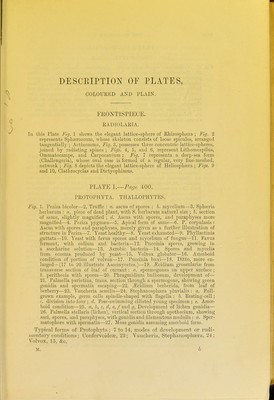
![PLATE LL—Faffe 412. PROTOPHYTA. ALG^. Fig. 27. CGramiuiu acanthonotiim—28. Closteiium, Tn])loceru.s gracilis— 29. Cosmarium radiatum—30. Micrasterias denticulata—31. Docidium liiistidai—32. Callitliamniou plumula—33. Diatoma, living : a. Licmophora splendida ; b. Achnanthes longipes ; c. Grammatophora marina. These figures are intended to show the general chai'acter of the eudochronie and growth of frustule—34. Callithamnion refractum—35. Juugerinanniu albi- cans ; b. representing elater and spores—36. Leaf with antlieridia, or male elements, represented more magnified at a to the left of the figure— 37. Ceramium ecliinotum — 38. Pleurosigma angulatum, side view — 39. Delesseria hypoglossum—40. Pleurosigma angulatum, front view, endo- clirome not represented—41. Ceramium flabelligerum. PLATE 111.—Page 479. PROTOZOA. Figs. 43, 44, 45, 46, 47, 48, 49, 50, 51, 52. These figures are from drawings made by Major Owen, to illustrate forms of living Polycystina, sketched from life ; these convey a faint idea of the riclily coloured appearance of the natural structure ; Figs. 48 to 52—53. Gregarina lumbricorum, round form— 54. Gregarina lumbricorum, the usual elongated form—55. Gregarina serpulas—56. Gregarina Sieboldii; illustration of septate form, with reflexed hook-like processes—57. Gregarina lumbricorum, encysted—58. Gregarina lumbricorum, more advanced and pseudo-navicellje forming—59. Gregaiina lumbricorum, free pseudo-navicella of—60, 61. Gregarina lumbricorum, amceboid forms of—62. Cruciate sponge-spicule—63. Astromma Himi- boldtii—64. Eozoon Canadense, represents appearance of a portion of the natural size—65. Eozoon Canadense, magnified, showing portions of cell- walls left uncoloured, the animal sarcode inhabiting it coloured dark green as in nature, and converted by fossilisation into a sQicious mineral; the narrow bands passing between these are processes (stolons) of the same substance—66. Actinoplirys sol, budding—67. Eugleua viridis : a. con- tracted; b. elongated form—68. Acineta tuberosa—69. Qilcistes longicornis (Davis) — 70. Oxytricha gibba (side view)—71. Oxytricha pellionella— 72. Tliuricola valvata, expanded—73. Cyclidium (glaucoma)—74. Oxytricha sciutillans—75 to 79, 80 to 85, illustrate types of Foraminifera discovered by Major Owen, living—75. Globigerina accrosa, n. sp., broken open to show interior—76. Globigerina, n. s.p., broken open to show interior—77. Globi- gerina hirsuta—78. Globigerina universa—79 and 81. G. BuUoides—SO. Conochilus vorticella—82. Globigerina inflata, sinistral shell-83. Pulviuuliua T\Iicheliniana—84. P. Canariensis—85. P. Menardii. PLATE IV.—Pa<7e 514. METAZOA. BRYOZOA. Fig. 86. Hartea elegans—87. Side view of Syiuipta spicula—88. Ophioglyph;<, rosula (very immature sjiccimcn): a. Claw hooks; I. palmate spicula. Tlic development of this species is described by G. Hodge, in Ti-ansactions of Tyuesidc Naturalists' Field-Club—89. Spine of a star-fish, particularly interesting as .sliowing the reticular calcareous network obtaining in this as in all other hard parts of the Echinodermata—90. Very minute Si)atangus,](https://iiif.wellcomecollection.org/image/b21443476_0024.jp2/full/800%2C/0/default.jpg)