The microscope : its history, construction, and application, being a familiar introduction to the use of the instrument, and the study of microscopical science / by Jabez Hogg.
- Jabez Hogg
- Date:
- 1898
Licence: Public Domain Mark
Credit: The microscope : its history, construction, and application, being a familiar introduction to the use of the instrument, and the study of microscopical science / by Jabez Hogg. Source: Wellcome Collection.
Provider: This material has been provided by University of Bristol Library. The original may be consulted at University of Bristol Library.
758/780 (page 686)
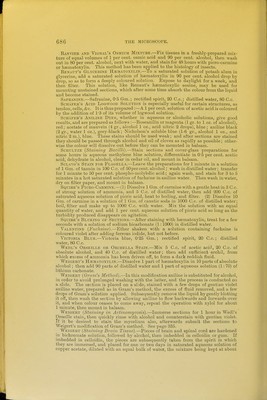
![Ranvteb and Vignal's Osmium Mixture.—Fix tissues in a freshly-prepared mix- ture of equal volumes of 1 per cent, osmic acid and 90 per cent, alcohol, then wash out in 80 per cent, alcohol, next with water, and stain for 48 hours with picro-carmine or hiBHiatoxylin. This method has been applied to the histology of insects. Renaut's Glyceuink HiioMATOXYLiN.—To a saturated solution of potash alum in glycerine, add a saturated solution of hasnuitoxylin in 90 per cent, alcohol droj) by drop, so as to form a deeply coloured solution. Expose to daylight for a week, and then filter. This solution, like Renaut's hsematoxylic eosine, may be used for mounting unstained sections, which after some time absorb the colour from the liquid and become stained. Safb.\nine.—Safranine, 0'5 Gm.; rectified spirit, 20 C.c.; distilled water, 80 C.c. Schafeb's Acid Logwood Solution is especially useful for certain structures, as tendon, cells, &c. It is thus prepared ;—A 1 per cent, solution of acetic acid is coloured by the addition of 1'3 of its volume of logwood solution. Scblafer's Aniline Dyes, whether in aqueous or alcoholic solutions, give good results, and are prepared as follows :—Roseanilin or magenta (1 gr. to 1 oz. of alcohol), red; acetate of mauvein (4 gr., alcohol 1 oz., acid nitric 2 drops), blue ; aniline black (2 gr., water 1 oz.), grey-black; Nicholson's soluble blue (1-6 gr., alcohol 1 oz., and nitric 2 m.), blue. These stains should be used weak; and after sections are stained they should be passed through alcohol and oil of cloves as rapidly as possible; other- wise the colour will dissolve out before they can be mounted in balsam. ScHULTZE {Staining Bacilli).—Stain sections and cover-glass preparations for some hours in aqueous methylene blue solution, differentiate in 0'6 per cent, acetic acid, dehydrate in alcohol, clear in cedar oil, and mount in balsam. Sclavo's Stain ron Flagella.—Leave the preparations for 1 minute in a solution of 1 Gm. of tannin in 100 C.c. of 50 per cent, alcohol; wash in distilled water; transfer for 1 minute to 50 per cent, pliospho-molybdic acid; again wash, and stain for 3 to 5 minutes in a hot saturated solution of fuchsine in aniline water. Then wash in w-ater, dry on filter paper, and mount in balsam. Squire's PicRO-CARmNE.—(1) Dissolve 1 Gm. of carmine with a gentle heat in 3 C.c. of strong solution of ammonia, and 5 C.c. of distilled water, then add 200 C.c. of saturated aqueous solution of picric acid, heat to boiling, and filter. (2) Dissolve 10 Gm. of carmine in a solution of 1 Gm. of caustic soda in 1000 C.c. of distilled water; boil, filter and make up to 1000 C.c. with water. Mix the solution with an equal quantity of water, and add 1 per cent, aqueous solution of picric acid so long as the tm-bidity produced disappears on agitation. Squire's Blueing or Sections.—After staining with heematoxylin, treat for a few seconds with a solution of sodium bicarbonate (1:1000) in distilled water. Valentine {Fuchsine).—Ether shaken with a solution containing fuchsine is colom-ed violet after adding ferrous iodide, but not before. Victoria Blue.—Victoria blue, 0'25 Gm.; rectified spirit, 20 C.c; distilled water, 80 C.c. Wedl's Obseille or Orchella Stain.—Mix 5 C.c. of acetic acid, 20 C.c. of absolute alcohol, and 40 C.c. of distilled water; then add sufficient archil, from which excess of ammonia has been driven off, to form a dark reddish fluid. Weigert's Hematoxylin.—Dissolve 1 part of liEematoxylin in 10 parts of absolute alcohol; then add 90 parts of distilled water and 1 part of aqueous solution (1:70) of lithium carbonate. Weigebt {Ch-am's Method).—In this modification aniline is substituted for alcohol, in order to avoid i^rolonged washing with the lattei', and the process is conducted on a slide. The section is placed on a slide, stained with a few drojis of gentian violet aniline water, prepared as in Gram's method, the excess of fluid removed, and a few drops of Gram's solution applied. Subsequently remove the liquid by gently blotting it off, then wash the section by allowing aniline to flow backwards and forwards over it, and when colour ceases to come away, I'epeat the operation with xj'lol for about 1 minute, then mount in balsam. Weigebt {Staining in Actinomycosis).—^Immerse sections for 1 hour in Wedl's Orseille stain, then quickly rinse with alcohol and counterstain with gentian violet. If it be desired to stain the mycelium also, afterwards submit the sections to Weigert's modification of Gram's method. See page 335. Weigebt (Staining Brain Tissue).—Pieces of brain and spinal cord are hardened in bichromate solution, followed by alcohol, then imbedded in celloidin or gum. If imbedded in celloidin, the pieces are subsequently taken from the spirit in which they are immersed, and ]ilaced for one or two days in saturated aqueous solution of copper acetate, diluted with an equal bulk of water, the mixture being kept at about](https://iiif.wellcomecollection.org/image/b21443476_0758.jp2/full/800%2C/0/default.jpg)