The microscope : its history, construction, and application, being a familiar introduction to the use of the instrument, and the study of microscopical science / by Jabez Hogg.
- Jabez Hogg
- Date:
- 1898
Licence: Public Domain Mark
Credit: The microscope : its history, construction, and application, being a familiar introduction to the use of the instrument, and the study of microscopical science / by Jabez Hogg. Source: Wellcome Collection.
Provider: This material has been provided by University of Bristol Library. The original may be consulted at University of Bristol Library.
760/780 (page 688)
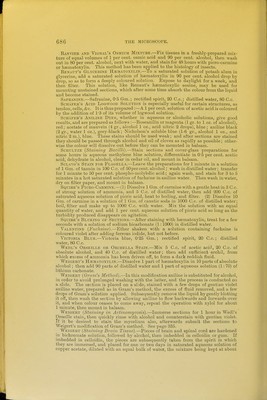
![From the unit of linear niuasure of metre is derived tlie unit of the measure of capacity or Lithk. Thin rcpreKentM tlic cube of one-tenth ])art of a metre, or a cubic decimetre, and its multiiiles and sub-divisions with theircoiTespondingequivalents in Imperial fluid measure are as follows :— 1 Myrialitre, Ml. = 10,000.0 L. = 2200.9(507 imperial gallons.* 1 Kilolitre, Kl. = ' 1,000.0 „ = 220.090(i 1 Hectolitre HI. = 100.0 „ = 22.009(5 1 Decalitre, Dl. = 10.0 „ = 2.2009 ,, ' 1 Litre, L. = 1.0 ,, = 35.21.')4 fluid ounces imperial. 1 Decihtre, dl. = 0.1 „ = 3.5215 „ „ „ 1 Centilitre, cl. = 0.01 „ = 0.3521 ., 1 Millilitre, ml. = 0.001 „ = 0.0352 „ or 1 Cubic Centimetre, ccm. = 0.001 L. = 0.0352 „ „ „ The unit of weight in the metric system is the Gbamme. This is also derived from the metre, and represents the weight of one cubic centimetre, of water, or the quantity of distilled water, at its maximum density, 4° C. (392'^ P.), wliich would fill the cube of one-hmidredth part of a metre. The relative value of the gramme, together with its multiples and sub-divisions, as compared with the English standards of weight, may be seen from the following table— 1 Myriagramme, Mg. = 10,000.0 Gm. = 22.0461 pounds. 1 Kilogramme, 1 Hectogi-anmie, Kg. = 1,000.0 )j 2.2046 Hg. 100.0 )) 3.5273 ounces avoir. 1 Decagramme, Dg. 10.0 )) ' 154.3235 gi-ains. 1 GB.\MjrE, Gm. 1.0 )) 15.4323 „ 1 Decigramme, cIg. 0.1 1.5432 1 Centigramme, eg- 0.01 0.1543 1 Milligramme, mg. 0.001 )' 0.0154 The expression micro-millimetre is used for microscopic measui'ements, and denotes the thousandth part of a millimetre. Of the measures of capacity, the terms most commonly employed are the litre and the cubic centimetre. Thus a decalitre may also be expressed as lO litres, a centilitre as 10 cubic centimetres, etc. Of the metric weights the gramme and its fractional parts, with their respective prefixes, are much used in analytical work. The kilogramme is largely employed in commercial trans- actions, and is commonly abbreviated kilo. As a comparison of the values of some of the more frequently employed expressions of the metric and English systems, the following may be found convenient for reference:— 1 mm. (millimetre) = 1/25 of an inch, cm. (centimetre) = 2/5 of an inch, inch = 25 millimetres of 22 centimetres, mg. (milligramme) = 0.01543 grain (or approx. 1/64 grain), gm. (gramme) = 15.4324 grains. Kg. ( Kilo or kilogramme) = 2 lbs. 3i ozs. av. pound avoir. = 453,592 grammes, ounce avoir. = 28,350 grammes, grain = 0.06479 granmie or 64.79 milligrammes, cc. (cubic centimetre) = 16.9 minims Imperial measure. L. (litre) = 35.21 fluid ounces Imperial measure, or 33.815 fluid ounces Wine measure. fluid ounce Imperial measure = 28.350 grammes, pint Imperial measure = 567.0 graimnes. 1 gallon Imperial measure = 4.53(5 litres, or 10 lbs. avoir, of pure water at 62° F. and under an atmospheric pressure of 30 inches of mercury. It may be well to bear in mind that on the Continent liquids are always weighed, not measured. Tlic imporiiU gallon contivins 277.2<:t84 cubic inclies, luid the iinpei iiil pint -JO fluiil ounces, whereas tlie ■wino gallon has 231 cubic inches ami the pint Ki fluid ounces. In wine measure 1 litre = Ki.SI& fluid oiuiocs.](https://iiif.wellcomecollection.org/image/b21443476_0760.jp2/full/800%2C/0/default.jpg)