Dialling, plain, concave, convex, projective, reflective, refractive. Shewing, how to make all such dials, and to adorn them with all useful furniture relating to the course of the sun; performed arithmetically, geometrically, instrumentally and mechanically: and illustrated with sculptures, engraven in copper, comprised in XIV distinct tractates... / [William Leybourn].
- William Leybourn
- Date:
- 1700
Licence: Public Domain Mark
Credit: Dialling, plain, concave, convex, projective, reflective, refractive. Shewing, how to make all such dials, and to adorn them with all useful furniture relating to the course of the sun; performed arithmetically, geometrically, instrumentally and mechanically: and illustrated with sculptures, engraven in copper, comprised in XIV distinct tractates... / [William Leybourn]. Source: Wellcome Collection.
25/440 page 3
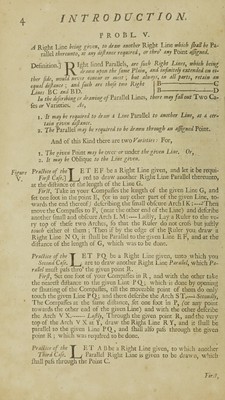
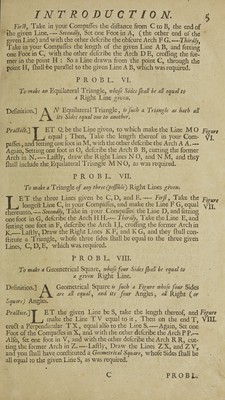
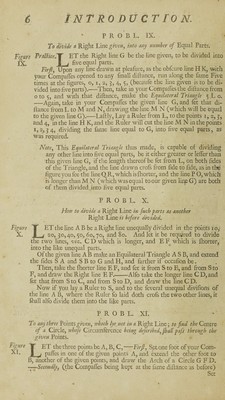
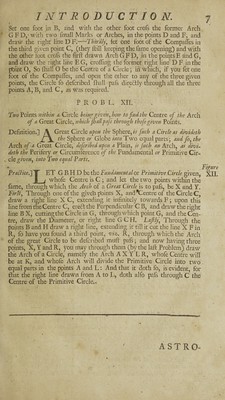
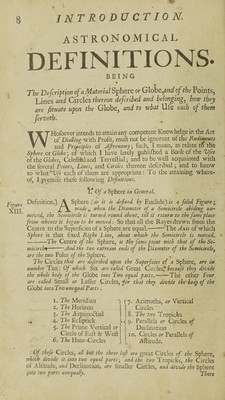
![■ P R O B L. III. From A Point above^ to let a Perpendicular/^// upn a Right Line under it, TN this there are two Cafes. — FirH, When the given point above, I is over (or nearj the of the given Line : And — Secondly^ ' When the given point is juft (or near) over the End of the given Line, \ * Fraltice.']^ N’ the fir II Cafe; Let NO be a Right Line given, and from J( the point P (over it) let it be required to let fall the Per- pendicular P Q.-Fir If Open the Compafles to any convenient di- ftance, greater than the Diftance between P and Q,; and fetting one foot in P, with the other draw an obfcure Arch of a Circle, cutting the given Line in the points R and S.-Secondly, Divide the fpace between R and S, into two equal parts in the point Q; So a Right Line drawn from the given point P, to the point Q, fhall be Perpendicular to the Line N O. A^ote, To avoid the dividing of the Space R S, into two equal parts, to find the point Q.; if you have room (either above or beneath your Line) you may fet one foot in S, and opening the Compaffes to any convenient diftance, make the Arch Y Y, and removing the Com- palfes to R, make the Arch Z Z, crofting the fotmer in JE, fo a ' Line drawn through M and P, fliall be perpendicular to N O. IfT the fecond Cafe; Let V be the point given; — Firll, From any part of the given Line N O ; as from T, draw a Right Line to the given point V, which divide into two equal parts inX.-Secondly, Set one foot of the Compalfes in X, and with the diftance XT defcribe the Arch (or Semicircle) VOT, cutting the given Line NO in O ; fo fhall O be the point, to which from the given point V, if you draw a Right Line, it fhall be a Perpendicular to the Line N O j and from the point V ; as was required. P R O B L. IV. To divide a Right Line into Trvo equal Parts, and.at Right (or Square) Angles. PraHice,'] T E T AB be a Line given, to be fo divided.^Take in J_j your Compaffes the length of the given Line A B, or any other diftance, greater than half the length thereof.; and fetting one foot in the end A, withvthe other draw the Arch C D E.--Second¬ ly, (the Compaffes being open at the fame diftance) Set one foot in Bj and with the other crofs the former Arch ( both above and below the Line) in the points F and G: So a Right Line drawn (or a Ruler laid) from F to G, fhall cut the given Line in H; fo fhall the given Line A B be divided into Two equal parts in the point H, and at Right Angles, which was required. Figuri IV. f](https://iiif.wellcomecollection.org/image/b30412377_0025.jp2/full/800%2C/0/default.jpg)

 No text description is available for this image
 No text description is available for this image
 No text description is available for this image