Dialling, plain, concave, convex, projective, reflective, refractive. Shewing, how to make all such dials, and to adorn them with all useful furniture relating to the course of the sun; performed arithmetically, geometrically, instrumentally and mechanically: and illustrated with sculptures, engraven in copper, comprised in XIV distinct tractates... / [William Leybourn].
- William Leybourn
- Date:
- 1700
Licence: Public Domain Mark
Credit: Dialling, plain, concave, convex, projective, reflective, refractive. Shewing, how to make all such dials, and to adorn them with all useful furniture relating to the course of the sun; performed arithmetically, geometrically, instrumentally and mechanically: and illustrated with sculptures, engraven in copper, comprised in XIV distinct tractates... / [William Leybourn]. Source: Wellcome Collection.
27/440 page 5
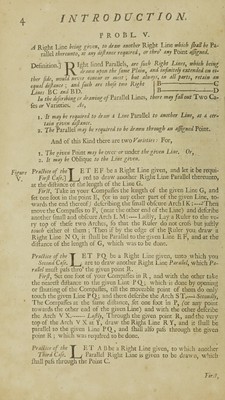
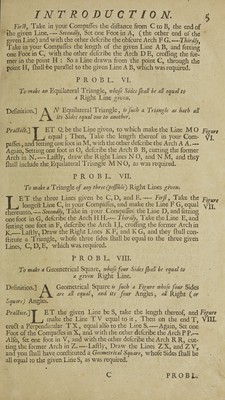
![Fir sty Take in your Compares the diftance from C to B, the end of * the given Line. — Secondlyy Set one Foot in A, (the other end of the ' given Line) and with the other defcribe the obfcure Arch F G. —Thirdlyy Take in your Compaifes the length of the given Line A B, and fetting - one Foot in C, with the other defcribe the Arch D E, crofling the for¬ mer in the point H : So a Line drawn from the point C, through the point H, (hall-be parallel to the given Line A B, which was required. I 4 P R O B L. VI. To make an Equilateral Triangle, whofe Sides fljall be all eq^ual td a Right Line given. Definition,] A N Equilateral Triangle, isfuch a Triangle as hath all • / \ its Sides equal one to another. Practice,'] X ET CL be the Line given, to which make the Line M O Fi<rure J_j equal ; Then, Take the length thereof in your Com- yj, palfes, and fetting one foot in M, with the other defcribe the Arch A A. — Again, Setting one foot in O, defcribe the Arch B B, cutting the former Arch in N. — Laftly, draw the RightXines N O, and N M, and they fliall include the. Equilateral Triangle M N O, as was required. P R O B L. VII. To make a Tmngh of any three Qoffible) Right Lines givem Let the three Lines given be C,D, and E.—- Firfiy Take the Figure longeft Line C, in your CompalTes, and make the Line F G, equal thereunto.—*- Secondlyy Take in your Corapalfes; the Line D, and fetting one foot in G, defcribe the Arch HH.— Tlnrdlyy Take the Line E,and fetting one foot in F, defcribe the Arch II, crolfmg the former Arch in _Laftly, Draw the Right Lines K F, and K G, and they fhall con- ftitute a Triangle, whofe three Tides fhall be equal to the three given Lines, C,D,E, which waa required. I . . P R O B L. VIII. To make a Geometrical Square, rvhofe four Sides fhall he equal to a given Right Line. ^ Definition.] \ Geometrical Squared fuch a Figure whofe four Sidts are all equaly and its four Angles, all (^or Square) Angles. Practice,'YT ET the given Line be S, take the length thereof, Figure J_j make the Line T V equal to it, Then on the end T, VIIL ere£I a Perpendicular T X, equal alfo to the Line S.—-Again, Set one Foot of the Compaffes in X, and with the other defcribe the Arch P P.— Alfo, fet one foot in V, and with the other defcribe the Arch RR, cut¬ ting the former Arch in Z.—Laftly, Draw the Lines ZX, and Z V,, and you ftiall have conftituted a Geometrical Squarey whofe Sides fliall be all equal to the given Line S, as was required. C PROBt.](https://iiif.wellcomecollection.org/image/b30412377_0027.jp2/full/800%2C/0/default.jpg)

 No text description is available for this image
 No text description is available for this image
 No text description is available for this image