Dialling, plain, concave, convex, projective, reflective, refractive. Shewing, how to make all such dials, and to adorn them with all useful furniture relating to the course of the sun; performed arithmetically, geometrically, instrumentally and mechanically: and illustrated with sculptures, engraven in copper, comprised in XIV distinct tractates... / [William Leybourn].
- William Leybourn
- Date:
- 1700
Licence: Public Domain Mark
Credit: Dialling, plain, concave, convex, projective, reflective, refractive. Shewing, how to make all such dials, and to adorn them with all useful furniture relating to the course of the sun; performed arithmetically, geometrically, instrumentally and mechanically: and illustrated with sculptures, engraven in copper, comprised in XIV distinct tractates... / [William Leybourn]. Source: Wellcome Collection.
73/440 page 47
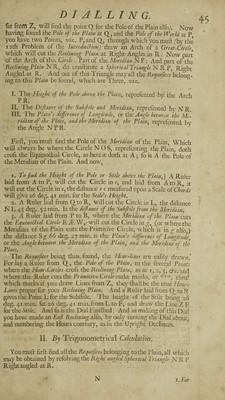
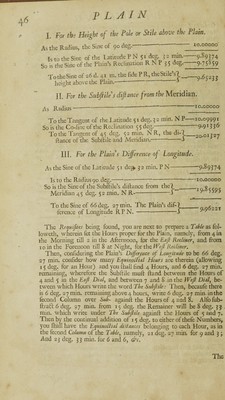
![As the Sine,of 90 deg.--- 41 •10—00000 To the Sine of the Stile’s height ^2 deg. 56 min.— So the Tang, of the n^xt Equin. dift. 21 deg. 25 inin.- To the Tangent of i i deg. 56 min_;_ 9—7 j 140 9—59^4 9—32494 Which I I deg. 56 min. is the Diftance of the Hour-Lines of Eleven or One of the Clock from the Subftiie. Arid ib of all the reft, as in the Table: Which being meafured upon the Primitive'Circle by help of a Scale of Chords, will be found the fame as where the Hour-Circles of the Projedion did cut the Primitive Circle* . CHAR XIII. • • Mow to draw Hour-Lines upon a South or North-Plain^ which declines many Degrees Mards the Eaft or Weft. F a Plain fhall be found to decline many Degrees from the North or South towards either Ea.fi or Wefi; as, abov^e 60 deg. Although the Requifites may be found, and the Dial made in all refpefts as 'the former Dial was in the laft Chapter, yet by reafon that the Pole of •the MWldy will have but fmall Elevation above fuch a Plam^ the Hour* Lines will fall fo clofe one to another, that there will be no competent diftance between them, till they be extended very far from the Cej^ter: And therefore, it was the way gf the Ancients, to draw the Dial upon a large Floor, and extend the Hour-lines., Stile and Subfiile, to a great length, that fo the Hour-lines might be of a convenient diftance; and then to cut the-DM/off, Stile and all, and fo transfer it to the Plain, But this being too Hechanical, I will here fliew a more artificial way how to draw fucli a Dial Geometrically, by help of a Line of Chords only, ha¬ ving no regard to the Center of the Dial.-Aild, ' V, By Trigonometrical Calculation. You rhuft find the Requifites : ]^arnely, (^i.) The height of the Pole.^ or Stile, above the Plain, {2.) The difiance of the Subfile from the Meri¬ dian. (3./ The Plaints dijference of Longitude. All which may be found by the foregoing Analogies, or Proportions; Suppofe therefore. An. Upright Plain, in the Latitude of.51 deg^ 32 min. fhould decline frorri the South, EaHward 85 deg. ' I. For the Stile’s height4 • As the Radius 90 deg.- To the ,Co-Sine of the Latitude 38 deg. 28 min.- So is the Co-Sine of the Platri^s declination 5 deg.-— To the Sirie of 3 deg. 6 min. the height of the Pole of StiIe-^8—73413 ^ . * M • IT* For —.10—^00000 —9—79384 . -^—8—94029](https://iiif.wellcomecollection.org/image/b30412377_0073.jp2/full/800%2C/0/default.jpg)
 No text description is available for this image
 No text description is available for this image
 No text description is available for this image