Volume 1
The chronicles of Enguerrand de Monstrelet / containing an account of the cruel civil wars between the houses of Orleans and Burgundy; of the possession of Paris and Normandy by the English; their expulsion thence; and of other memorable events that happened in the kingdom of France, as well as in other countries ... Beginning at the year MCCCC, where that of Sir John Froissart finishes, and ending at the year MCCCCLXVII, and continued by others [J. du Clercq? and P. Desrey] to the year MDXVI. Translated by Thomas Johnes.
- Enguerrand de Monstrelet
- Date:
- 1849
Licence: Public Domain Mark
Credit: The chronicles of Enguerrand de Monstrelet / containing an account of the cruel civil wars between the houses of Orleans and Burgundy; of the possession of Paris and Normandy by the English; their expulsion thence; and of other memorable events that happened in the kingdom of France, as well as in other countries ... Beginning at the year MCCCC, where that of Sir John Froissart finishes, and ending at the year MCCCCLXVII, and continued by others [J. du Clercq? and P. Desrey] to the year MDXVI. Translated by Thomas Johnes. Source: Wellcome Collection.
590/690 (page 546)
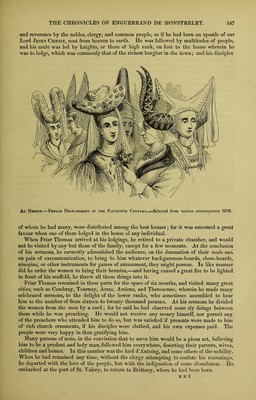
![stroke to himself and his kingdom. For this reason he had sent thither his most expert and faithful officers, namely, Boussac, the lord d’Eu, the bastard of Orleans, the lords de Gaucourt, de Graville, de Yilain, Poton de Saintrailles, la Hire, sir Theolde de Valperghe, sir Louis de Vaucourt, with others renowned in arms, and of great authority. They had under their daily command from twelve to fourteen hundred combatants, well tried and enterprising; but sometimes more and sometimes less,—for the town was not so completely suiTounded but that the besieged could replenish themselves with provision or stores when- ever they pleased. Very many sallies and skirmishes took place during the siege, but it would be tiresome to relate the various successes that attended them; but from what I have heard from well- informed persons, I do not find that the besieged did any great damage to the enemy, except with their cannon and other like instruments from their walls. By one of these was slain sir Lancelot de Lisle, a very valiant English knight, and renowned in arms. CHAPTER LIII. A PREACHER, CALLED FRIAR THOMAS, CONVERTS MANY PERSONS, AND INVEIGHS AGAINST THE EXTRAVAGANT DRESSES OF THE WOMEN, IN DIFFERENT PLACES. In this year, a friar called Thomas Conecte, a native of Brittany, and of the Carmelite order, was much celebrated through parts of Flanders, the Tournesis, Artois, Cambresis, Ternois, in the countries of Amiens and Ponthieu, for his preachings. In those towns where it was known he intended to preach, the chief burghers and inhabitants had erected for him in the handsomest square, a large scaffold, ornamented with the richest cloths and tapestries, on which was placed an altar, whereon he said mass, attended by some monks of his order, and his disciples. The greater part of these last followed him on foot wherever he went, he himself riding on a small mule. Having said mass on this platform, he then preached long sermons, blaming the vices and sins of each individual, more especially those of the clergy, who publicly kept mistresses, to the breach of their vows of chastity. In like manner, he blamed greatly the noble ladies, and all others who dressed their heads in so ridiculous a manner, and who expended such large sums on the luxuries of apparel. He was so vehement against them, that no woman thus dressed dared to appear in his presence ; for he was accustomed, when he saw any of them with such dresses, to excite the little boys to torment and plague them, giving them certain days of pardon for so doing, and which he said he had the power of granting. He ordered the boys to shout after them, Au hennin, au hennin!* even when the ladies were departed from him and from hearing his invectives; and the boys pursuing them, endea- voured to pull down these monstrous head-dresses, so that the ladies were forced to seek shelter in places of safety. These cries caused many tumults between those who raised them and the servants of the ladies. Friar Thomas, nevertheless, continued his abuse and invectives so loudly, that no women with high head-dresses any longer attended his sermons, but dressed in caps somewhat like those worn by peasants and people of low degree. The ladies of rank, on their return from these sermons, were so much ashamed, by the abusive expressions of the preacher, that the greater part laid aside their head-dresses, and wore such as those of nuns. But this reform lasted not long, for like as snails, when any one passes by them, draw in their horns, and when all danger seems over put them forth again,—so these ladies, shortly after the preacher had quitted their country, forgetful of his doctrine and abuse, began to resume their former colossal head-dresses, and wore them even higher than before. Friar Thomas, however, acquired very great renown in the towns wherein he preached, from all ranks of people, for the boldness and justness of his remonstrances, more especially for those addressed to the clergy. He was received wherever he went with as much respect * An hennin. This was the name given by the preacher in the ] 5th century. For further particulars, see the to those ridiculous colossal head-dresses worn hy the ladies French Encyclopedic, vol, viii.](https://iiif.wellcomecollection.org/image/b22011845_0001_0590.jp2/full/800%2C/0/default.jpg)