Volume 1
The chronicles of Enguerrand de Monstrelet / containing an account of the cruel civil wars between the houses of Orleans and Burgundy; of the possession of Paris and Normandy by the English; their expulsion thence; and of other memorable events that happened in the kingdom of France, as well as in other countries ... Beginning at the year MCCCC, where that of Sir John Froissart finishes, and ending at the year MCCCCLXVII, and continued by others [J. du Clercq? and P. Desrey] to the year MDXVI. Translated by Thomas Johnes.
- Enguerrand de Monstrelet
- Date:
- 1849
Licence: Public Domain Mark
Credit: The chronicles of Enguerrand de Monstrelet / containing an account of the cruel civil wars between the houses of Orleans and Burgundy; of the possession of Paris and Normandy by the English; their expulsion thence; and of other memorable events that happened in the kingdom of France, as well as in other countries ... Beginning at the year MCCCC, where that of Sir John Froissart finishes, and ending at the year MCCCCLXVII, and continued by others [J. du Clercq? and P. Desrey] to the year MDXVI. Translated by Thomas Johnes. Source: Wellcome Collection.
595/690 (page 551)
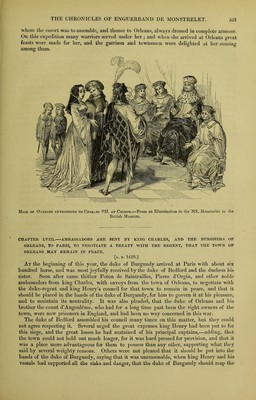
![where the escort was to assemble, and thence to Orleans, always dressed in complete armour. On this expedition many warriors served under her; and when she arrived at Orleans great feasts were made for her, and the garrison and townsmen were delighted at her coming among them. Maid of Ok leans introduced to Chajuks VII. at Chinon.—From an Illumination in the MS. Monstvelet in the British Museum. CHAPTER LVIII. AMBASSADORS ARE SENT BY KING CHARLES, AND THE BURGHERS OF ORLEANS, TO PARIS, TO NEGOTIATE A TREATY WITH THE REGENT, THAT THE TOWN OF ORLEANS MAY REMAIN IN PEACE. [a. d. 1429.] At the beginning of this year, the duke of Burgundy arrived at Paris with about six hundred horse, and was most joyfully received by the duke of Bedford and the duchess his sister. Soon after came thither Poton de Saintrailles, Pierre d’Orgin, and other noble ambassadors from king Charles, with envoys from the town of Orleans, to negotiate with the duke-regent and king Henry’s council for that town to remain in peace, and that it should be placed in the hands of the duke of Burgundy, for him to govern it at his pleasure, and to maintain its neutrality. It was also pleaded, that the duke of Orleans and his brother the count d’Angouleme, who had for a long time past been the right owners of the town, were now prisoners in England, and had been no way concerned in this war. The duke of Bedford assembled his council many times on this matter, but they could not agree respecting it. Several urged the great expenses king Henry had been put to for this siege, and the great losses he had sustained of his principal captains,—adding, that the town could not hold out much longer, for it was hard pressed for provision, and that it was a place more advantageous for them to possess than any other, supporting what they said by several weighty reasons. Others were not pleased that it should be put into the hands of the duke of Burgundy, saying that it was unreasonable, when king Henry and his vassals had supported all the risks and danger, that the duke of Burgundy should reap the](https://iiif.wellcomecollection.org/image/b22011845_0001_0595.jp2/full/800%2C/0/default.jpg)