Volume 1
The chronicles of Enguerrand de Monstrelet / containing an account of the cruel civil wars between the houses of Orleans and Burgundy; of the possession of Paris and Normandy by the English; their expulsion thence; and of other memorable events that happened in the kingdom of France, as well as in other countries ... Beginning at the year MCCCC, where that of Sir John Froissart finishes, and ending at the year MCCCCLXVII, and continued by others [J. du Clercq? and P. Desrey] to the year MDXVI. Translated by Thomas Johnes.
- Enguerrand de Monstrelet
- Date:
- 1849
Licence: Public Domain Mark
Credit: The chronicles of Enguerrand de Monstrelet / containing an account of the cruel civil wars between the houses of Orleans and Burgundy; of the possession of Paris and Normandy by the English; their expulsion thence; and of other memorable events that happened in the kingdom of France, as well as in other countries ... Beginning at the year MCCCC, where that of Sir John Froissart finishes, and ending at the year MCCCCLXVII, and continued by others [J. du Clercq? and P. Desrey] to the year MDXVI. Translated by Thomas Johnes. Source: Wellcome Collection.
87/690 (page 43)
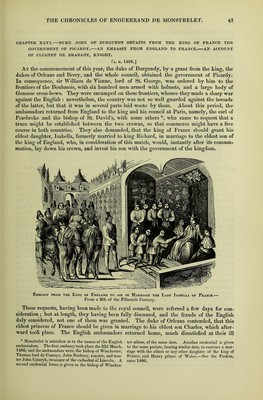
![CHAPTER XXVI. DEICE JOHN OF BURGUNDY OBTAINS FROM THE KING OF FRANCE THE GOVERNMENT OF PICARDY. AN EMBASSY FROM ENGLAND TO FRANCE. AN ACCOUNT OF CLUGNET DE BRABANT, KNIGHT. Ta. d. 1406.] At tlie commencement of this year, the duke of Burgundy, by a grant from the king, the dukes of Orleans and Berry, and the whole council, obtained the government of Picardy. In consequence, sir William de Yienne, lord of St. George, was ordered by him to the frontiers of the Boulonois, with six hundred men armed with helmets, and a large body of Genoese cross-bows. They were encamped on these frontiers, whence they made a sharp war against the English : nevertheless, the country was not so well guarded against the inroads of the latter, but that it was in several parts laid waste by them. About this period, the ambassadors returned from England to the king and his council at Paris, namely, the earl of Pembroke and the bishop of St. David’s, with some others *, who came to request that a truce might be established between the two crowns, so that commerce might have a free course in both countries. They also demanded, that the king of France should grant his eldest daughter, Isabella, formerly married to king Richard, in marriage to the eldest son of the king of England, who, in consideration of this match, would, instantly after its consum- mation, lay down his crown, and invest his son with the government of the kingdom. Embassy prom the King of England to ask in Marriage the Lady Isabella of France.— From a MS. of the Fifteenth Century. These requests, having been made to the royal council, were referred a few days for con- sideration ; but at length, they having been fully discussed, and the frauds of the English duly considered, not one of them was granted. The duke of Orleans contended, that this eldest princess of France should be given in marriage to his eldest son Charles, which after- ward took place. The English ambassadors returned home, much dissatisfied at their ill * Monstrelet is mistaken as to the names of the English ter alone, of the same date. Another credential is given ambassadors. The first embassy took place the 22d March, to the same prelate, hearing similar date, to contract a mar- 1406, and the ambassadors were, the bishop of Winchester, riage with the eldest or any other daughter of the king of Thomas lord do Camoys, John Norbury, esquire, and mas- France, and Henry prince of Wales.—See the Feeders, ter John Cateryk, treasurer of the cathedral of Lincoln. A anno 1406. second credential letter is given to the bishop of Winches-](https://iiif.wellcomecollection.org/image/b22011845_0001_0087.jp2/full/800%2C/0/default.jpg)