The relative mortality after amputations of large and small hospitals : and the influence of the antiseptic (Listerian) system upon such mortality / by Henry C. Burdett.
- Henry Burdett
- Date:
- 1882
Licence: Public Domain Mark
Credit: The relative mortality after amputations of large and small hospitals : and the influence of the antiseptic (Listerian) system upon such mortality / by Henry C. Burdett. Source: Wellcome Collection.
Provider: This material has been provided by the Francis A. Countway Library of Medicine, through the Medical Heritage Library. The original may be consulted at the Francis A. Countway Library of Medicine, Harvard Medical School.
10/52 (page 6)
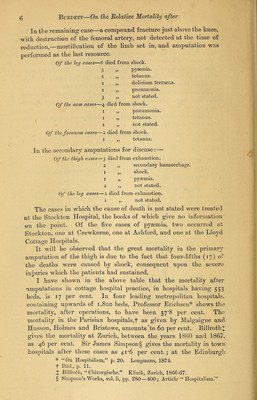
![In tlie remaining case—a compound fracture just above the knee, witli destruction of the femoral artery, not detected at the time of reduction,—mortification of the limb set in, and amputation was performed as the last resource. Of the leg cases—6 died from shock. 3 ,, pjaemia. 1 „ tetanus. I „ delirium tremens. I ,, pneumonia. 3 „ not stated. Of the arm eases—4 died from shocks I „ pneumonia. I „ tetanus. I ,, not stated. Of the forearm cases—2 died from shock. 1 „ tetanus. In the secondary amputations for disease:— Of the thigh cases—3 died from exhaustion. 2 „ secondary haemorrhage. I 5, shock. I „ pyaemia. z „ not stated. Of the leg cases— z died from exhaustion. ] „ not stated. The cases in which the cause of death is not stated were treated at the Stockton Hospital, the books of which give no information on the point. Of the five cases of pyaemia, two occurred at Stockton, one at Crewkerne, one at Ashford, and one at the Lloyd Cottage Hospitals. It will be observed that the great mortality in the primary amputation of the thigh is due to the fact that four-fifths (17) of the deaths were caused by shock, consequent upon the severe injuries which the patients had sustained. I have shown in the above table that the mortality after amputations in cottage hospital practice, in hospitals having 553 beds, is 17 per cent. In four leading metropolitan hospitals, containing upwards of 1,800 beds, Professor Erichsen* shows the mortality, after operations, to have been 37'8 per cent. The mortality in the Parisian hospitals,t ^s given by Malgaigne and HussoQ, Holmes and Bristowe, amounts to 60 per cent. Billroth;]; gives the mortality at Zurich, between the years 1860 and 1867, as 46 per cent. Sir James Simpson § gives the mortality in town hospitals after these cases as 41*6 per cent.; at the Edinburgh * On Hospitahsm, p. 20. Longmans, 1874. t Ibid., p. 11. X Bilkoth, Chirurgische. Kliuik, Zurich, 1866-67. § Simpson's Works, vol. ii, pp. 280—400 j Article Hospitalism.](https://iiif.wellcomecollection.org/image/b21044508_0010.jp2/full/800%2C/0/default.jpg)