Volume 1
On the anatomy, physiology, and pathology of the chimpanzee / by Charles F. Sonntag.
- Sonntag, Charles F. (Charles Frederick), -1925
- Date:
- 1923
Licence: In copyright
Credit: On the anatomy, physiology, and pathology of the chimpanzee / by Charles F. Sonntag. Source: Wellcome Collection.
101/118 page 421
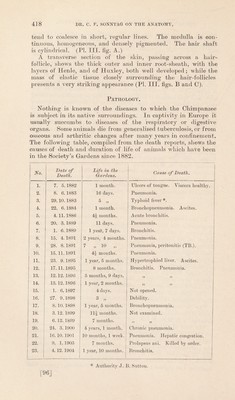
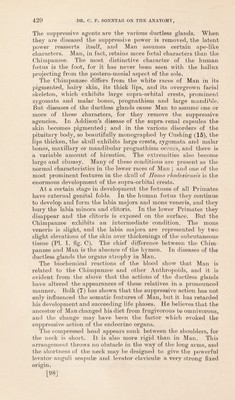
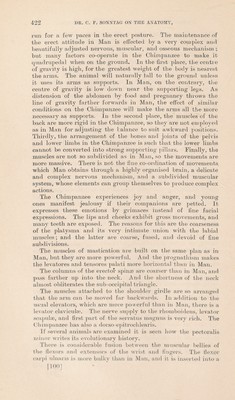
![If some object is held above the animal’s head one can see that there is a considerable upward movement of the eyeballs, but the head does not move much. And the greater upward movement of the eyes compared with that in Man is effected by a more posterior attachment of the inferior oblique muscle. The Chimpanzee uses its arms as hook-like suspenders, but the diminutive thumb is of no great use for suspension. The new- born child can, it is well known, support the weight of its body for a half to two minutes in a similar manner. Its fingers reflexly assume this position if one places his index finger in its Much has been written about the attitude of the Chimpanzee, but the conclusions, in several instances, have been drawn from the study of dead material, or from the observation of sluggish animals moving clumsily across the floors of their cages. Those who have observed Chimpanzees in their natural haunts testify to their activity and agility ; and I have been fortunate in being able to examine a male Uganda Chimpanzee, lately arrived at the Gardens, which still exhibits much of its oriainal activitv. It runs about actively, using its arms and legs almost equally ; it occasionally uses its foot as a spring-board; and it swings about on the branches in its cage very actively. Anatomical descriptions state that the Chimpanzee keeps its knees semi-flexed and give that as one of the factors which prevent the animal from assuming the erect attitude. And Humphry (20) states that one cannot fully extend the knee without doing violence to the muscles. If, however, the living animal is examined a different state of affairs can be observed ; but the observations must be long and frequent. I observed the active animal mentioned above extending its joints fully, both during active progression and while standing up and holding on to the bars of its cage. Two young animals were then examined during their active movements, and the same conditions were observed. After studying the active range of movement I examined the passive movements in two other young animals, and I found that I could easily extend the knees; but the curvature of the upper end of the tibia gave the leg an apparent slight flexion even when the knee is lightly extended. It is, therefore, evident, from the results obtained on these five living animals that the knee-joint can be fully extended. The position of semi-flexion is, however, more comfortable in the Chimpanzee, as it is in Man, and an animal which becomes sluggish in captivity will develop stiff joints, so full extension of the knee will then become impossible, either actively or passively. And I believe that some anatomical accounts have been based on the examination of limbs so affected. If the animal were deprived of its arms it could not stand upright like Man, but it can under momentum be erect for a short period; I have observed the active animal mentioned above [99]](https://iiif.wellcomecollection.org/image/b2982123x_0001_0101.jp2/full/800%2C/0/default.jpg)



 No text description is available for this image
 No text description is available for this image
 No text description is available for this image