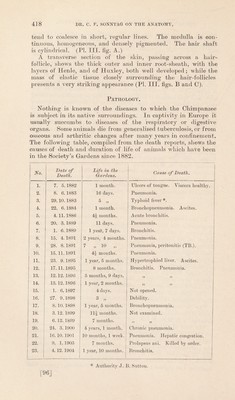
Volume 1
On the anatomy, physiology, and pathology of the chimpanzee / by Charles F. Sonntag.
- Sonntag, Charles F. (Charles Frederick), -1925
- Date:
- 1923
Licence: In copyright
Credit: On the anatomy, physiology, and pathology of the chimpanzee / by Charles F. Sonntag. Source: Wellcome Collection.
102/118 page 422
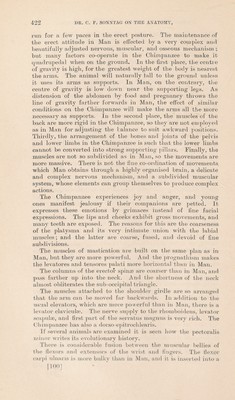
![run for a few paces in the erect posture. The maintenance of the erect attitude in Man is effected by a very complex and beautifully adjusted nervous, muscular, and osseous mechanism ; but many factors co-operate in the Chimpanzee to make it quadrupedal when on the ground. In the first place, the centre of gravity is high, for the greatest weight of the body is nearest the arms. The animal will naturally fall to the ground unless it uses its arms as supports. In Man, on the contrary, the centre of gravity is low down near the supporting legs. As distension of the abdomen by food and pregnancy throws the line of gravity farther forwards in Man, the effect of similar conditions on the Chimpanzee will make the arms all the more necessary as supports. In the second place, the muscles of the back are more rigid in the Chimpanzee, so they are not employed as in Man for adjusting the balance to suit awkward positions. Thirdly, the arrangement of the bones and joints of the pelvis and lower limbs in the Chimpanzee is such that the lower limbs cannot be converted into strong supporting pillars. Finally, the muscles are not so subdivided as in Man, so the movements are more massive. There is not the fine co-ordination of movements, which Man obtains through a highly organised brain, a delicate and complex nervous mechanism, and a subdivided muscular system, whose elements can group themselves to produce complex actions. The Chimpanzee experiences joy and anger, and young ones manifest jealousy if their companions are petted. It expresses these emotions by grimaces instead of fine facial expressions. The lips and cheeks exhibit gross movements, and many teeth are exposed. The reasons for this are the coarseness of the platysma and its very intimate union with the labial muscles; and the latter are coarse, fused, and devoid of fine subdivisions. The muscles of mastication are built on the same plan as in Man, but they are more powerful. And the prognathism makes the levatores and tensores palati more horizontal than in Man. The columns of the erector spinse are coarser than in Man, and pass farther up into the neck. And the shortness of the neck almost obliterates the sub-occipital, triangle. The muscles attached to the shoulder girdle are so arranged that the arm can be moved far backwards. In addition to the usual elevators, which are more powerful than in Man, there is a levator claviculae. The nerve supply to the rhomboideus, levator scapulae, and first part of the serratus magnus is very rich. The Chimpanzee has also a dorso-epitroclilearis. If several animals are examined it is seen how the pectoralis minor writes its evolutionary history. There is considerable fusion between the muscular bellies of the flexors and extensors of the wrist and fingers. The flexor carpi ulnaris is more bulky than in Man, and it is inserted into a [100]](https://iiif.wellcomecollection.org/image/b2982123x_0001_0102.jp2/full/800%2C/0/default.jpg)