Volume 1
On the anatomy, physiology, and pathology of the chimpanzee / by Charles F. Sonntag.
- Sonntag, Charles F. (Charles Frederick), -1925
- Date:
- 1923
Licence: In copyright
Credit: On the anatomy, physiology, and pathology of the chimpanzee / by Charles F. Sonntag. Source: Wellcome Collection.
17/118 page 337
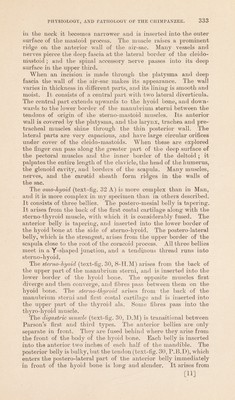
![Man from the oblique line on the thyroid cartilage and from the side of the cricoid. Its fibres sweep more or less upwards, overlap the lower border of the middle constrictor and blend with the opposite muscle in the mid-dorsal line. It has no origin from the first tracheal ring as in Gratiolet’s specimen (22). The stylo-pliaryngeus (text-fig. 32, S.P) arises from the tendon of the stylo-glossus, but Gratiolet (22) states that it rises from the base of the styloid apophysis. It splits up into bundles some of which are inserted into the superior and middle constrictors, others passing between these muscles and radiating in the wall of the pharynx. The glosso-pharyngeal nerve hooks round it and sends it a well-marked branch. The levator palati and tensor palati (text-fig. 29 B) arise by a strong, common musculo-aponeurotic origin from the apex of the petrous temporal bone, the under surface of the Eustachian tube and the scaphoid fossa. So the separate origins of the muscles have fused in this animal. The levator palati (L.P) runs downwards and forwards and spreads out between the layers of the palato-pharyngeus. The tensor palati (T.P) is even more horizontal. Its tendon winds round the pterygoid hamulus and is inserted by several small tendinous and fascial bundles in the palatal aponeurosis. The complete limits of the palato-pharyngeus (P.P) could not be accurately made out, and the palato-glossus hardly exists. The azygos uvulce (A.U) ends posteriorly in membrane as pointed out by Gratiolet (22). The thyro-hyoid runs from the entire width of the thyroid ala to the under and outer surfaces of the body and great cornu of the hyoid bone. Its nerve from the hypoglossal is well marked. The scalenus anticus arises from the anterior tubercles of the transverse processes of the third, fourth, and fifth cervical vertebrae, but others have given its origin from 4, 5, and 6. It is connected by a tendon to the rectus capitis anticus major. It is inserted as in Man, the tubercle on the first rib being lateral to the chondro-costal junction. The scalenus mediusand scalenus posticus arise as in Man. They unite to form a flat sheet which courses downwards to be attached to the outer surfaces of the first five ribs. The fusion and extent are greater than that described by Gratiolet (22) and others. It is crossed posteriorly by the slips of insertion of the upward continuation of the sacro- spinalis. The omo-trachelian runs as usual from the transverse process of the atlas to the upper and outer aspect of the acromion. It has been recorded by some as being not an omo-trachelian, but as an acromio-basilaris. Muscles and Fasciae of the Back. The fascia covering the trapezius and latissimus dorsi is of great strength, especially below. It is attached above to the occipital crest, mesially to the vertebral spines and below to the [15]](https://iiif.wellcomecollection.org/image/b2982123x_0001_0017.jp2/full/800%2C/0/default.jpg)
 No text description is available for this image
 No text description is available for this image
 No text description is available for this image