Volume 1
On the anatomy, physiology, and pathology of the chimpanzee / by Charles F. Sonntag.
- Sonntag, Charles F. (Charles Frederick), -1925
- Date:
- 1923
Licence: In copyright
Credit: On the anatomy, physiology, and pathology of the chimpanzee / by Charles F. Sonntag. Source: Wellcome Collection.
18/118 page 338
![iliac crest. It is continuous with the fascia over the gluteal muscles. Laterally it is continuous with deep fascia of the neck, thorax and limbs. The trapezius arises from the inner third of the occipital crest, the external occipital protuberance, all cervical spines, the thirteen dorsal spines and the supraspinous ligament. There is no ligamentum nuchae, so the origin differs from that in Man. Various authors have recorded it as arising from the first ten or twelve dorsal spines. The lower border is not fused with the latissimus dorsi, as described by Champneys (11), Bland Sutton (4), and others, though some anatomists did observe fusion. Close to the lower angle of the scapula there is a triangle of auscul- tation similar to that in Man. The whole origin is muscular, there being no aponeurosis close to the vertebral spines as there is in Man. It is inserted into the outer third of the posterior- border of the clavicle, some fibres passing into the deltoid, the outer border of the acromion and the whole length of the spine of the scapula. The most lateral part of the spinous insertion is aponeurotic. There is no differentiation of fibres inserted into a special area on the root of the spine of the scapula as there is in Man. The spinal accessory nerve can be traced almost to the lower border of the muscle, and gives off numerous branches to it. It communicates with the third and fourth cervical nerves, but there is no marked sub-trapezial nerve plexus. It divides at the root of the neck into two marked branches. One of these goes to the cervical part of the trapezius and the other to the thoracic part. The latissimus dorsi arises from the lower five dorsal spines and supraspinous ligaments, the posterior lamella of the lumbo- dorsal fascia and the posterior lip of the iliac crest from the highest point to the anterior superior spine, where it overlaps the outer border of the external oblique. It also receives slips from the ninth, tenth and eleventh ribs, but none from the inferior angle of the scapula. On the ribs, whence it derives slips, it fuses with the origin of the external oblique. The. strong tendon is inserted into the floor of the bicipital groove on the humerus, and is extensively fused with the teres major and dorso-epitrochlearis. No band runs across the axillary vessels. Bland-Sutton (4) emphasises the absence of the latter slip. Champneys (11) gives the costal origin as ribs 10-13, and mentions a lesser adhesion to the teres major. Hepburn (24) gives its origin from the anterior half of the outer lip of the iliac crest; and records three costal slips ; he also mentions slight fusion with the teres major. The rhomboideus is an undivided sheet arising from the last two cervical and first four dorsal spines. It is inserted into the lower three-fourths of the vertebral border of the scapula. The insertion reaches higher than the root of the spine of the scapula, and its upper part overlaps the insertion of the levator anguli scapulae. Gratiolet (22) described the origin as extending from [16]](https://iiif.wellcomecollection.org/image/b2982123x_0001_0018.jp2/full/800%2C/0/default.jpg)
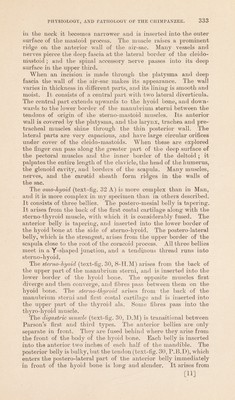
 No text description is available for this image
 No text description is available for this image
 No text description is available for this image