Volume 1
On the anatomy, physiology, and pathology of the chimpanzee / by Charles F. Sonntag.
- Sonntag, Charles F. (Charles Frederick), -1925
- Date:
- 1923
Licence: In copyright
Credit: On the anatomy, physiology, and pathology of the chimpanzee / by Charles F. Sonntag. Source: Wellcome Collection.
19/118 page 339
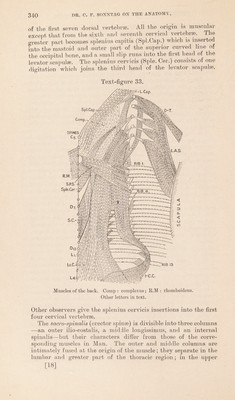
![the occiput to the seventh dorsal spine. The sheet is undivided into major and minor muscles, in which it agrees with that described by Gratiolefc (22), Yrolik (51), Macalister (33), Bland- Sutton (4), and Wilder (53). Champneys (22) describes major and minor rhomboids in great detail. The levator anguli scapulae (text-fig. 33, L.A.S) arises by five slips from the posterior tubercles of the first five cervical vertebrae, the first being the largest. The lower three origins are tendinous and fused with splenius cervicis. It is inserted into the upper fourth of the vertebral border of the scapula. It is not adherent to serratus magnus, nor is it divisible into two parts. Champ- neys (11) gives the origin as the first two cervical vertebrae; Gratiolet (22) gives it as the second and third ; Hepburn (24) records origins from three cervical vertebrae ; Wilder (53) gives it as in Man, and Bland-Sutton (4) records it as springing from the first five. The serratus posticus superior (text-fig. 33, S.P.S) arises by a thin aponeurosis from the spinous processes of the seventh cervical and first dorsal vertebrae, and it is inserted by four muscular slips into the outer surfaces of the first four ribs at their angles. Macalister (33) describes it crossing the first two ribs to be attached to the third and fourth. The serratus posticus inferior arises from the posterior lamella of the lumbo-dorsal fascia and sweeps antero-laterally to be inserted into the lower borders of ribs nine to thirteen just external to their angles. Bland-Sutton (4) gives its attachments as ribs nine to twelve. The lumbo-dorsal fascia is arranged as in Man. The thoracic part is thin and transparent, and it is difficult to separate it off from the subjacent muscles as a continuous sheet. The lumbar part is very dense and strong. The posterior lamella is not easily separated from the latissimus dorsi, to which it gives origin. Posterior branches of the spinal nerves pass through its deep surface. In its lower part it gives origin to the serratus posticus inferior. Between the outer and middle lamellae the erector spinae is present, and the attachments of the middle lamella are as in Man. The quadratus lumborum lies between the moderately strong middle lamella and the weaker internal lamella, whose attachments to the arcuate ligaments of the diaphragm are as in Man. In the possession of a serratus posticus inferior the Chimpanzee resembles Man, and that muscle is one of the three charac- teristically human muscles. It will be seen later that the Chimpanzee possesses the plantaris, which is the second human muscle, but it does not possess the peroneus tertius. The muscles of the back described above are relatively stronger than in Man, and they are relatively weaker than the pectorales, but the total bulk of these groups has probably diminished during captivity. The splenius (text-fig. 33) arises from the sides of the tips of the fifth, sixth, and seventh cervical vertebrae, and from the spines [17]](https://iiif.wellcomecollection.org/image/b2982123x_0001_0019.jp2/full/800%2C/0/default.jpg)
 No text description is available for this image
 No text description is available for this image
 No text description is available for this image