Volume 1
On the anatomy, physiology, and pathology of the chimpanzee / by Charles F. Sonntag.
- Sonntag, Charles F. (Charles Frederick), -1925
- Date:
- 1923
Licence: In copyright
Credit: On the anatomy, physiology, and pathology of the chimpanzee / by Charles F. Sonntag. Source: Wellcome Collection.
23/118 page 343
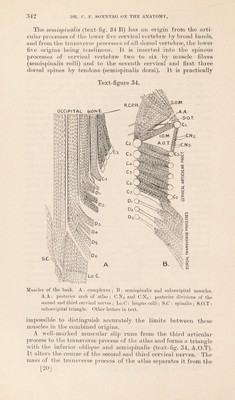
![origin of the rectus capitis lateralis, and the latter is the only muscle whose fibres run in the same direction *. The multifidus spince extends from the sacrum to the axis. It arises from the sacrum, sacro-iliac ligament, mammillary pro- cesses of the lumbar vertebrae, transverse processes of all dorsal vertebrae, and lower four cervical articular processes. It is inserted into the spines of all vertebrae except the atlas. The semispinalis covers it but its fibres, which run in the same direction, are longer than those of the multifidus, and extend to vertebrae farther apart. The cervical fibres of the multifidus do not form broad bands. The obliquus inferior (I.O.M) and obliquus superior (S.O.M) (text-fig. 34 B) are as in Man. The rectus capitis posticus major (text-fig. 34, R.C.P.M) is a powerful pyramidal muscle quite concealing the minor muscle. It arises from the spinous process of the axis and is inserted into the occiput below the entire length of the superior oblique. The rectus capitis posticus minor arises from the inner three-quarters of an inch of the posterior arch of the atlas and is inserted into the occipital bone below the major muscle. It is quite concealed by the latter, and by the approximation of the walls of the sub- occipital triangle. Rectus capitis lateralis is as in Man. Interspinales, intertransversarii and levatores costarum are as in Man. Rotatores dorsi are twelve pairs of fan-shaped muscles running from the transverse processes of the dorsal vertebrae to the laminae of the vertebrae above them, the first one being in- serted into the seventh cervical lamina. Muscles of the Thoracic Parietes. The external intercostal muscles run in the same direction as those in Man. They extend from the angles of the ribs to the sternum in the first three and last two spaces. But there are external intercostal membranes in the other spaces. The internal intercostals do not differ materially from those in Man. The triangularis sterni arises as in Man from the back of the ensiform cartilage, and it is inserted by radiating slips into the sternal ends of the second, third, fourth, fifth, and sixth ribs. It has a slightly different relation to the internal mammary artery from that in Man, the details being given with that vessel on page 386. The sternalis muscle is absent. Some authors describe it, and their observations have been collected by Keith (29). Contrary to the conditions in Man, there is a well-marked lateral branch of the first intercostal nerve. It runs over the pectoralis major and fades away among the glands in the axilla. Prevertebral Muscles. The longus colli consists, as in Man, of vertical, superior, oblique and inferior oblique portions. The vertical part arises from the * This is probably an individual peculiarity. 23* [21]](https://iiif.wellcomecollection.org/image/b2982123x_0001_0023.jp2/full/800%2C/0/default.jpg)
 No text description is available for this image
 No text description is available for this image
 No text description is available for this image