Volume 1
On the anatomy, physiology, and pathology of the chimpanzee / by Charles F. Sonntag.
- Sonntag, Charles F. (Charles Frederick), -1925
- Date:
- 1923
Licence: In copyright
Credit: On the anatomy, physiology, and pathology of the chimpanzee / by Charles F. Sonntag. Source: Wellcome Collection.
6/118 page 326
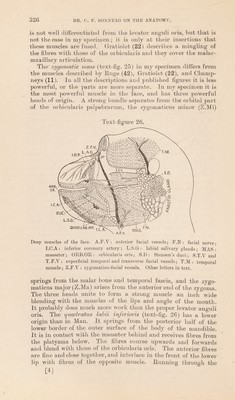
![is not well differentiated from the levator anguli oris, but that is not the case in my specimen; it is only at their insertions that these muscles are fused. Gratiolet (22) describes a mingling of the fibres with those of the orbicularis and they cover the malar- maxillary articulation. The' zygomatic mass (text-fig. 25) in my specimen differs from the muscles described by Huge (42), Gratiolet (22), and Cliamp- neys (11). In all the descriptions and published figures it is less powerful, or the parts are more separate. In my specimen it is the most powerful muscle in the face, and has three powerful heads of origin. A. strong bundle separates from the orbital part of the orbicularis palpebrarum, the zygomaticus minor (Z.Mi) Text-figure 26. Deep muscles of the face. A.F.Y: anterior facial vessels; F.N : facial nerve; I.C.A : inferior coronary artery ; L.S.G : labial salivary glands ; MAS : masseter; ORB.OR : orbicularis oris; S.D : Stensen’s duct; S.T.V and T.F.V : superficial temporal and transverse facial vessels; T.M : temporal muscle ; Z.F.V : zygomatico-facial vessels. Other letters in text. springs from the malar bone and temporal fascia, and the zygo- maticus major (Z.Ma) arises from the anterior end of the zygoma. The three heads unite to form a strong muscle an inch wide blending with the muscles of the lips and angle of the mouth. It probably does much more work than the proper levator anguli oris. The quadratus labii inferioris (text-fig. 26) has a lower origin than in Man. It springs from the posterior half of the lower border of the outer surface of the body of the mandible. It is in contact with the masseter behind and receives fibres from the platysma below. The fibres course upwards and forwards and blend with those of the orbicularis oris. The anterior fibres are fine and close together, and interlace in the front of the lower lip with fibres of the opposite muscle. Running through the [4]](https://iiif.wellcomecollection.org/image/b2982123x_0001_0006.jp2/full/800%2C/0/default.jpg)