Volume 1
On the anatomy, physiology, and pathology of the chimpanzee / by Charles F. Sonntag.
- Sonntag, Charles F. (Charles Frederick), -1925
- Date:
- 1923
Licence: In copyright
Credit: On the anatomy, physiology, and pathology of the chimpanzee / by Charles F. Sonntag. Source: Wellcome Collection.
64/118 page 384
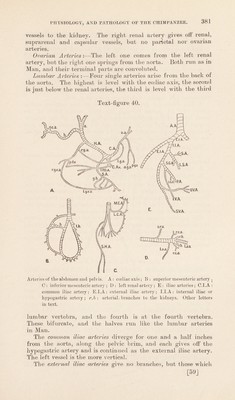
![combined linguo-facial artery (L.F.T) is given off at tlie point where the external carotid changes its direction. After an upward and forward course of half an inch it divides into lingual and external maxillary arteries. The lingual artery runs horizontally and disappears under cover of the hyo-giossus muscle after giving off a large branch to the submaxillary gland. It then courses between the hyo-glossus and middle constrictor of the pharynx ; and in this situation it gives off supra-hyoid and muscular arteries. Emerging from under the anterior border of the hyo-glossus, it passes forwards and dips downwards between the stylo-glossus and sublingual gland laterally and the genio-glossus mesially. It sinks into the latter, and can be traced to a communication with its neigh- bour below the apex of the tongue. The external maxillary artery (text-fig. 41, E.M.A) runs first forwards and upwards on the upper surface of the submaxillary gland, then between the gland and the mandible. At the anterior border of the masseter it crosses on to the outer surface of the mandible and gets into the face (text-fig. 26). There it runs in a curved, but not convoluted, course to the angle of the mouth, where it becomes more vertical; and it ends in the levator anguli oris. It is concealed by the platysma and zygomatic mass, and it lies on the surface of quadratus labii superioris and buccinator. It gives off several branches to the outer surface of the submaxillary gland (S.M.G). In the face (text-fig. 26) it gives off masseteric (M.A.S), inferior labial (I.L.A), inferior coronary (l.C.A), and superior labial (S.L. A) vessels, whose dis- tributions are shown in the figure. The submaxillary branches send vessels to the mylohyoid. The transverse facial artery (text-fig. 28) runs forwards between the parotid and masseter, supplying both, and then along the zygoma. The internal maxillary artery (text-fig. 29 A) has the same course as in Man, but it lies on the surface of the externa] ptery- goid. It gives off the following branches :— A. In the Pterygoid Region :— 1. Numerous pteiygoid branches to the muscles, especially to the insertion of the external pterygoid. 2. Inferior dental artery (1.14.A) which runs as in Man along with the inferior dental nerve. 3. Meningeal artery (M.A) which passes deep to the external pterygoid, and divides into middle and accessory arteries, which enter the skull as in Man. 4. Buccal artery (B.A) accompanying the long buccal nerve. 5. Fine arteries to the suctorial pad of fat (S.P.F). 6. Posterior superior dental (P.S.D) to the gums round the molar teeth. 7. Two large, deep temporal arteries (D.T.A) which run up in the substance of the temporal muscle and anastomose freelv. L62]](https://iiif.wellcomecollection.org/image/b2982123x_0001_0064.jp2/full/800%2C/0/default.jpg)
 No text description is available for this image
 No text description is available for this image
 No text description is available for this image