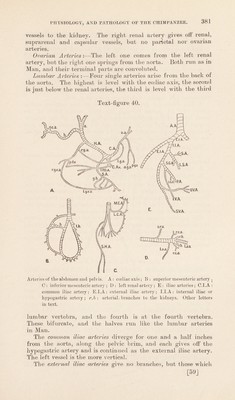
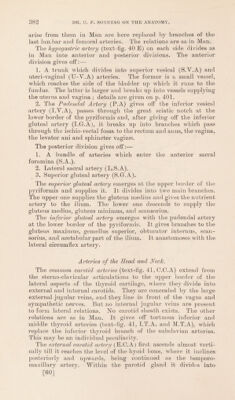
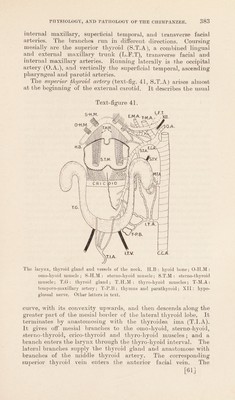
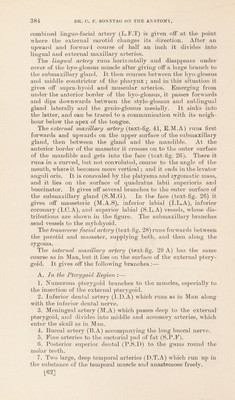
Volume 1
On the anatomy, physiology, and pathology of the chimpanzee / by Charles F. Sonntag.
- Sonntag, Charles F. (Charles Frederick), -1925
- Date:
- 1923
Licence: In copyright
Credit: On the anatomy, physiology, and pathology of the chimpanzee / by Charles F. Sonntag. Source: Wellcome Collection.
65/118 page 385
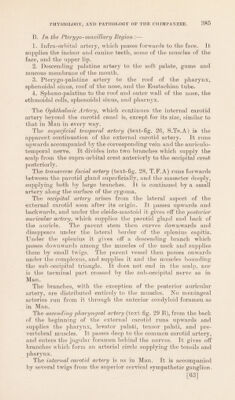
![B. In the Pterygo-maxillary Region :— 1. Infra-orbital artery, which passes forwards to the face. It supplies the incisor and canine teeth, some of the muscles of the face, and the upper lip. 2. Descending palatine artery to the soft palate, gums and mucous membrane of the mouth. 3. Pterygo-palatine artery to the roof of the pharynx, sphenoidal sinus, roof of the nose, and the Eustachian tube. 4. Spheno-palatine to the roof and outer wall of the nose, the ethmoidal cells, sphenoidal sinus, and pharnyx. The Ophthalmic Artery, which continues the internal carotid artery beyond the carotid canal is, except for its size, similar to that in Man in every way. The superficial temporal artery (text-fig. 26, S.Te.A) is the apparent continuation of the external carotid artery. It runs upwards accompanied by the corresponding vein and the auriculo- temporal nerve. It divides into two branches which supply the scalp from the supra-orbital crest anteriorly to the occipital crest posteriorly. The transverse facial artery (text-fig. 28, T.F.A) runs forwards between the parotid gland superficially, and the masseter deeply, supplying both by large branches. It is continued by a small artery along the surface of the zygoma. The occipital artery arises from the lateral aspect of the external carotid soon after its origin. It passes upwards and backwards, and under the cleido-mastoid it gives off the posterior auricular artery, which supplies the parotid glajid and back of the auricle. The parent stem then curves downwards and disappears under the lateral border of the splenius capitis. Under the splenius it gives off a descending branch which passes downwards among the muscles of the neck and supplies them by small twigs. The parent vessel then passes onwards under the complexes, and supplies it and the muscles bounding the sub-occipital triangle. It does not end in the scalp, nor is the terminal part crossed by the sub-occipital nerve as in Man. The branches, with the exception of the posterior auricular artery, are distributed entirely to the muscles. No meningeal arteries run from it through the anterior condyloid foramen as in Man. The ascending pharyngeal artery (text-fig. 29 B), from the back of the beginning of the external carotid runs upwards and supplies the pharynx, levator palati, tensor palati, and pre- vertebral muscles. It passes deep to the common carotid artery, and enters the jugular foramen behind the nerves. It gives off branches which form an arterial circle supplying the tonsils and pharynx. The internal carotid artery is as in Man. It is accompanied by several twigs from the superior cervical sympathetic ganglion. [63]](https://iiif.wellcomecollection.org/image/b2982123x_0001_0065.jp2/full/800%2C/0/default.jpg)