Volume 1
On the anatomy, physiology, and pathology of the chimpanzee / by Charles F. Sonntag.
- Sonntag, Charles F. (Charles Frederick), -1925
- Date:
- 1923
Licence: In copyright
Credit: On the anatomy, physiology, and pathology of the chimpanzee / by Charles F. Sonntag. Source: Wellcome Collection.
86/118 page 406
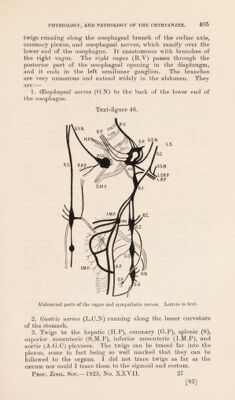
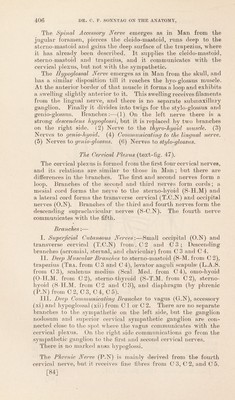
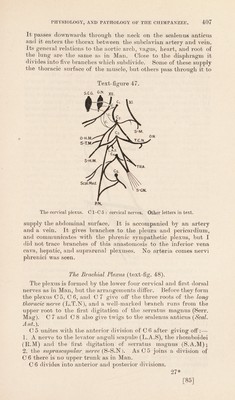
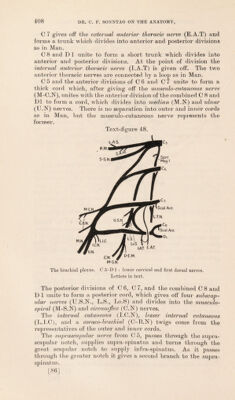
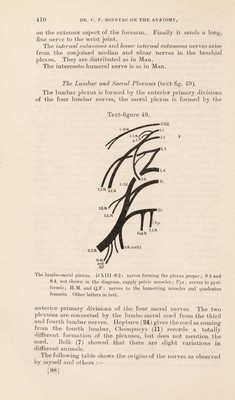
![The Spinal Accessory Nerve emerges as in Man from the jugular foramen, pierces the cleido-mastoid, runs deep to the sterno-mastoid and gains the deep surface of the trapezius, where it has already been described. It supplies the cleido-mastoid, sterno-mastoid and trapezius, and it communicates with the cervical plexus, but not with the sympathetic. The Hypoglossal Nerve emerges as in Man from the skull, and has a similar disposition till it reaches the hyo-glossus muscle. At the anterior border of that muscle it forms a loop and exhibits a swelling slightly anterior to it. This swelling receives filaments from the lingual nerve, and there is no separate submaxillary ganglion. Finally it divides into twigs for the stylo-glossus and genio-glossus. Branches:—(1) On the left nerve there is a strong clescendens hypoglossi, but it is replaced by two branches on the right side. (2) Nerve to the thyro-hyoid muscle. (3) Nerves to genio-hyoid. (4) Communicating to the lingual nerve. (5) Nerves to genio-glossus. (6) Nerves to stylo-glossus. The Cervical Plexus (text-fig. 47). The cervical plexus is formed from the first four cervical nerves, and its relations are similar to those in Man; but there are differences in the branches. The first and second nerves form a loop. Branches of the second and third nerves form cords; a mesial cord forms the nerve to the sterno-hyoid (S-H.M) and a lateral cord forms the transverse cervical (T.C.N) and occipital nerves (O.N). Branches of the third and fourth nerves form the descending supraclavicular nerves (S-C.N). The fourth nerve communicates with the fifth. Branches:— I. Superficial Cutaneous Nerves :■—Small occipital (O.N) and transverse cervical (T.C.N) from. C 2 and C 3 ; Descending- branches (acromial, sternal, and clavicular) from C 3 and C 4. II. Beep Muscidar Branches to sterno-mastoid (S-M. from C 2), trapezius (Tra. from C 3 and C 4), levator anguli scapulae (L.A.S. from C 3), scalenus medius (Seal. Med. from C 4), omo-hyoid (O-H.M. from C 2), sterno-thyroid (S-T.M. from C 2), sterno- hyoid (S-H.M. from C2 and C 3), and diaphragm (by phrenic (P.N) from C 2, C 3, C 4, 0 5). III. Beep Communicating Branches to vagus (G.N), accessory (xi) and hypoglossal (xii) from Cl or C 2. There are no separate branches to the sympathetic on the left side, but the ganglion nodosum and superior cervical sympathetic ganglion are con- nected close to the spot where the vagus communicates with the cervical plexus. On the right side communications go from the sympathetic ganglion to the first and second cervical nerves. There is no marked ansa hypoglossi. The Phrenic Nerve (P.N) is mainly derived from the fourth cervical nerve, but it receives fine fibres from C 3, C 2, and C 5. [84]](https://iiif.wellcomecollection.org/image/b2982123x_0001_0086.jp2/full/800%2C/0/default.jpg)
 No text description is available for this image
 No text description is available for this image
 No text description is available for this image