Volume 1
On the anatomy, physiology, and pathology of the chimpanzee / by Charles F. Sonntag.
- Sonntag, Charles F. (Charles Frederick), -1925
- Date:
- 1923
Licence: In copyright
Credit: On the anatomy, physiology, and pathology of the chimpanzee / by Charles F. Sonntag. Source: Wellcome Collection.
97/118 page 417
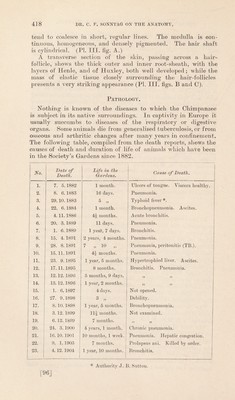
![Doran (71) pointed out that the auditory ossicles, taken as a whole, resemble those of Man more than do those of the Gorilla and Orang. But in these Anthropoids the ossicles resemble those of Man more than do those of the Chimpanzee in a few points. In the Chimpanzee the malleus is more human than those of the Gorilla and Orang. “ In the shape of its head, which projects markedly forwards, and in the nature of its articular surface, of which the outer segment is much the widest;, it approaches T. gorilla more than Homo or Sim la \ but in the neck and manubrium it is very human, the only difference being that the latter, in this ape, is narrower at the base, and more curved than in Man, and its well-developed processus brevis is directed upwards, and hardly outwards. In length the handle does not exceed that of our species—another prominent distinc- tion from the other two apes. The body of the incus resembles that in Homo : the processus brevis is more slender, and ends in a sharp point, with no trace of any depression on it. The processus longus is rather stouter and shorter than in Man ; it forms with the posterior crus a right angle. The stapes is smaller than in Man. The crura are almost equally curved; they are shorter and more slender than in Man, but wider apart at their insertion. They are well grooved towards the aperture which is wide. The base resembles that of Homo, though less distinctly reniform, and equally rounded off at both extremities.” The Skin and; Tegumentary Organs. As the Chimpanzee uses the extensor surfaces of his fingers in progression the skin has become modified. On the penultimate phalanges it exhibits long, oval callosities; and it has papillary ridges on its terminal ones. These ridges appear to increase during the period of growth, and Kidd (56) after describing their longitudinal direction states : “ their long axes are at right angles to the line of progression of the animal. There is no correlation between the act of prehension and the direction of the ridges, though it agrees closely with the general rule which obtains in so many regions, that the ridges lie at right angles to the line of incidence of the predominating pressure on the part.” The mammae are two in number, and pectoral in position. The umbilicus was very faint in this specimen. The following account of the comparative histology of the hairs of the Anthropoid Apes has been written by Mr. F. Martin Duncan, F.R.M.S., F.Z.S.: — The hair of the Chimpanzee is lank, coarse in texture, and jet black in hue. Microscopically it presents certain interesting features. The cuticular scales are well marked, narrow, and of the imbricate-ovate type characteristic of the Anthropoid Apes, and in contour bear a closer resemblance to Gorilla than to Simia. In the cortex, between the cuticular scales and the medulla, the pigment granules are very numerous, opaque, and [95]](https://iiif.wellcomecollection.org/image/b2982123x_0001_0097.jp2/full/800%2C/0/default.jpg)



 No text description is available for this image
 No text description is available for this image
 No text description is available for this image