Volume 1
On the anatomy, physiology, and pathology of the chimpanzee / by Charles F. Sonntag.
- Sonntag, Charles F. (Charles Frederick), -1925
- Date:
- 1923
Licence: In copyright
Credit: On the anatomy, physiology, and pathology of the chimpanzee / by Charles F. Sonntag. Source: Wellcome Collection.
99/118 page 419
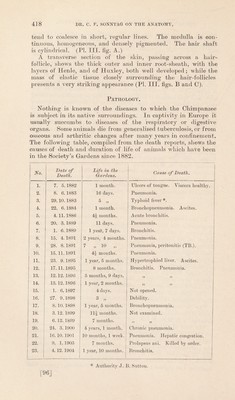
![No. i Date of Death. Dife in the Gardens. Cause of Death. 24. 20. 3.1905 1 month. Generalised tuberculosis. 25. 16. 1.1906 3 months, 3 days. Colitis. 26. 24. 4.1907 4 years, 0 months. Trauma. 27. 7. 9.1907 2 „ 5 „ Ulcerative colitis. 28. 19.11.1907 3 years, 12 days. Colitis. Enteritis. 29. 6. 7.1908 1 year, 2 months. Bronchopneumonia. 30. 8. 7.1908 3 years, 2 months. 55 55 31. 20.12.1917 4 „ 7 „ Fracture of skull. 32. 9. 1,1918 7 „ 3 „ Pneumonia. 33. 1. 8.1919 10 „ 10 „ Chronic arthritis. 34. 7.10.1922 2 ,, 6 „ Pneumonia. It has been shown by Metschnikoff, Roux, Neisser, and Lassar that the Chimpanzee is more susceptible to the virus of syphilis than any other Ape or Monkey. The primary lesions appear in thirty days after inoculation ; the secondary symptoms develop after a further period of more than thirty days; but tertiary signs have never been observed. All experimental inoculations with the gonococcus have failed to produce a result. Keith has collected papers by Owen (75, 76), Schmidt (77), Rollet (78), and Meyer (79) on the pathology of the Chimpanzee. And the works of Ehrlich and Hata give accounts of the trans- missibility of yaws to Apes ; but the actual Apes employed have not been mentioned. I desire to express my thanks to Dr. Doreen Stranger, Dr. J. H. James, Miss Kalian and Messrs. Aurounin, Henderson, Meneces, and McCormick, students in the Anatomy Department of University College, for their assistance in the dissection of the animal described above. Comparisons with Man. The Chimpanzee resembles Man in a general way in form and structure, but it differs from him in many respects. Some of the differences are associated with habits and diet; others are dependent on differences in the size and complexity of the brain; and others again are the outcome of different developmental processes. At a certain stage the foetuses of the Chimpanzee and Man have several features in common, but the subsequent develop- mental changes—both intrauterine and extrauterine—proceed in different directions. In the Chimpanzee they are marked by a progressive increase in certain parts, such as the hair and facial skeleton. In Man, on the other hand, they are characterised by suppression; but the power to develop farther lies dormant. [97]](https://iiif.wellcomecollection.org/image/b2982123x_0001_0099.jp2/full/800%2C/0/default.jpg)



 No text description is available for this image
 No text description is available for this image
 No text description is available for this image