Note on the knee-jerk and the correlation of action of antagonistic muscles / by C. S. Sherrington.
- Charles Scott Sherrington
- Date:
- [1893]
Licence: Public Domain Mark
Credit: Note on the knee-jerk and the correlation of action of antagonistic muscles / by C. S. Sherrington. Source: Wellcome Collection.
Provider: This material has been provided by UCL Library Services. The original may be consulted at UCL (University College London)
13/16 page 564
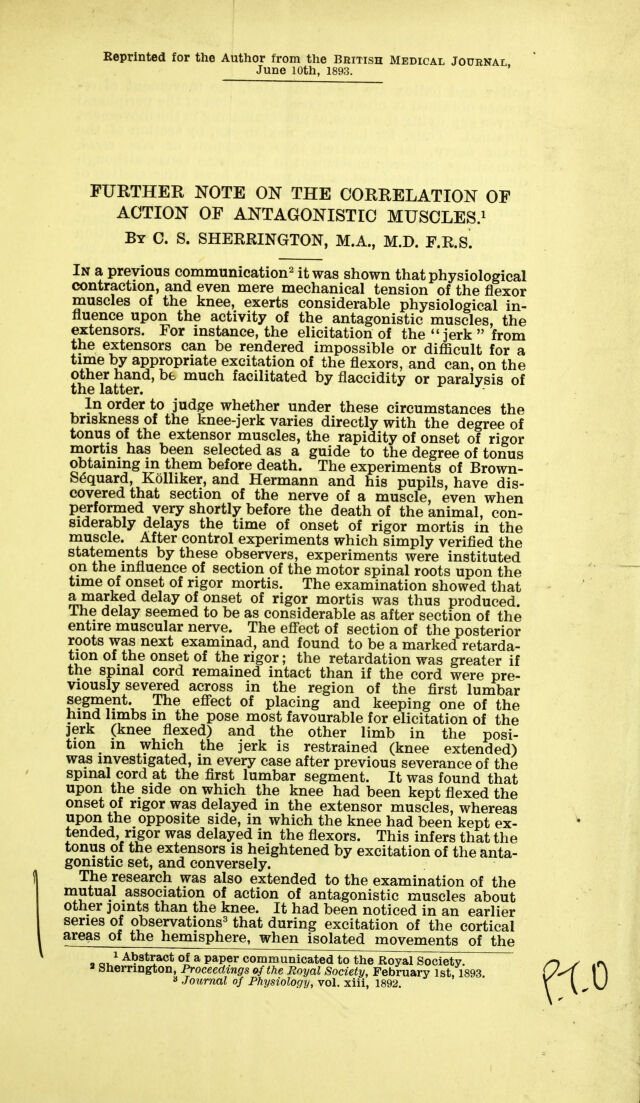
![experiments. Anatomical evidence is at present so scanty regarding ai^erent nerve fibres from muscle that investigation of their ana- tomical relation seems absolutely requisite for examining the problem further. [Just as the lumbo-sacral region of the cord may be split along the median plane without interference to the jerk of either side,* so the same may be done without hindering the above ascending reflex abolition of the jerk. Extinction of the jerk by exciting the central end of the 8th root (from hamstrings) affects the jerk four segments higher without in that distance spreading over to the opposite side. But the excitation affects the jerk of the opposite side if the scope of a considerable length of cord be allowed it. If in the Cat the cord be transversely divided at the 11th thoracic segment, excitation of the afferent fibres from a hamstring muscle of one side (e.gr., right) applies chiefiy to the jerk on the same side (right), but also to the jerk on the opposite. If, however, in the Cat (in which jerk belongs to the 6th and 5th lumbar segments) the cord be transversely cut at or below the 3rd, the extinction from the hamstring nerve is confined to the same side only. In other words, the presence of additional higher segments seems requisite before the passage of the impulses in question across the median plane of the cord, a fact in curious harmony with an observation by Hallstenf regarding the elicitation of crossed reflexes in the frog. The median posterior column between the 8th and 4th lumbar levels can be removed in toto without impairing the influence of the hamstring nerve on the jerk. It is clear also that those fibres of the posterior root which pass to Clarke's column cannot be the requisite afferents, either from the extensor or flexor thigh muscles, because the jerk and the above-described extinc- tion of it are unaffected in the Cat by transverse section of the cord just below the 4th lumbar segment, i.e., the segment where Clarke's column stops short.—February 8, 1893.] * Sherrington, ' Journ. of Physiol.,' toI. 13, p. 666. t ' Archiv f. Physiol.,' 1885. 'ffAREISON AND SONS, PEINTEES IN OEDINAEY TO HFE itfAJESTY, ST. MAETIN's LANE.](https://iiif.wellcomecollection.org/image/b21638159_0015.jp2/full/800%2C/0/default.jpg)


 No text description is available for this image
 No text description is available for this image
 No text description is available for this image