A report on a plan for transporting wounded soldiers by railway in time of war : with descriptions of various methods employed for this purpose on different occasions / by George A. Otis.
- George Alexander Otis
- Date:
- 1875
Licence: Public Domain Mark
Credit: A report on a plan for transporting wounded soldiers by railway in time of war : with descriptions of various methods employed for this purpose on different occasions / by George A. Otis. Source: Wellcome Collection.
Provider: This material has been provided by the Francis A. Countway Library of Medicine, through the Medical Heritage Library. The original may be consulted at the Francis A. Countway Library of Medicine, Harvard Medical School.
33/72 page 25
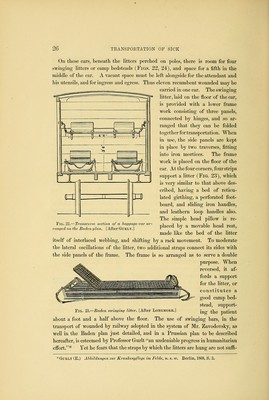
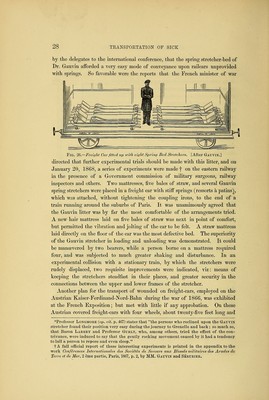
![Fig. 20.—Longitudinal section of one-third of a haggage-car, icith litters swung on the Baden plan. [After GuELT.] accompanying drawings. The apparatus is intended for use in covered bag- gage cars, the litters being suspended upon swinging bars of tou.gh wood. The bars or poles are provided at each end with iron caps or bands with projecting loops, connected by leathern straps and buckles with iron hooks. The bars are hung transversely about four feet apart (Fig. 20) to iron rings secured by eye-bolts in the side of the car. These rings are commonly found in cattle cars, in the proper places; but if not they must be inserted (Fig. 21). Oa each pair of the swinging bars, (and one pair is put in the fore-part and one in the rear- part of the car) two or three litters may be placed, which permits six re- cumbent patients to be carried on the swinging cross-bars. The litters consist of a wooden frame, on the upper surface of which are stretched, trans- versely and longitudinally, broad, closely-interlacing hempen bands of girth web- bing. There are foot-boards perforated for the attachment of apparatus, and well upholstered pillows support the head. They are furnished with handles of three-fourths of an inch iron tubing, which, when not in use, slide into the side-poles of the stretchers, and thus diminish the space occupied by the latter in the cars. There are also supplementary leathern loop-handles (Fig. 20) and straps by which the litters may be buckled, to re- strain their sliding on the transverse bars. A similar plan may be applied to third-class cars, (which in Grermany are not subdivided into compartments). The cross bars used for this purpose are shorter, their extremities similarly provided, however, with hooks. The bars are hooked to the upright backs of the seats, and hang lengthwise in the car, and two or three litters may be laid upon them transversely. But the contrivance was best adapted to the covered freight cars and fourth-class passenger cars used on the German railroads. Fig. 21.—Enlarged vieio of the mode of suspending the swing bars, a, eye- bolt and ring; b, hook; c, strap and buckle. [After Gurlt].](https://iiif.wellcomecollection.org/image/b2107110x_0033.jp2/full/800%2C/0/default.jpg)



 No text description is available for this image
 No text description is available for this image
 No text description is available for this image