A report on a plan for transporting wounded soldiers by railway in time of war : with descriptions of various methods employed for this purpose on different occasions / by George A. Otis.
- George Alexander Otis
- Date:
- 1875
Licence: Public Domain Mark
Credit: A report on a plan for transporting wounded soldiers by railway in time of war : with descriptions of various methods employed for this purpose on different occasions / by George A. Otis. Source: Wellcome Collection.
Provider: This material has been provided by the Francis A. Countway Library of Medicine, through the Medical Heritage Library. The original may be consulted at the Francis A. Countway Library of Medicine, Harvard Medical School.
34/72 page 26
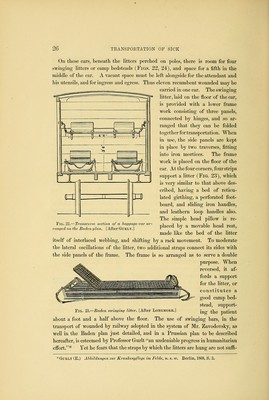
![On these cars, beneath the litters perched on poles, there is room for four swinging litters or camp bedsteads (Figs. 22, 24), and space for a fifth in the middle of the car. A vacant space must be left alongside for the attendant and his utensils, and for ingress and egress. Thus eleven recumbent wounded may be carried in one car. The swinging litter, laid on the floor of the car, is provided with a lower frame work consisting of three panels, connected by hinges, and so ar- ranged that they can be folded together for transportation. When in use, the side panels are kept in place by two traverses, fitting into iron mortices. The frame work is placed on the floor of the car. At the four corners, four strips support a litter (FiG. 23), which is very similar to that above des- cribed, having a bed of reticu- lated girthing, a perforated foot- board, and sliding iron handles, and leathern loop handles also. The simple head pillow is re- placed by a movable head rest, made like the bed of the litter itself of interlaced webbing, and shifting by a rack movement. To moderate the lateral oscillations of the litter, two additional straps connect its sides with the side panels of the frame. The frame is so arranged as to serve a double purpose. When reversed, it af- fords a support for the litter, or constitutes a good camp bed- stead, support- FiG. 2Z.—Baden sicinging litter. [After Longmoee.] j^j^, ^^ patient about a foot and a half above the floor. The use of swinging bars, in the transport of wounded by railway adopted in the system of Mr. Zavodovsky, as well in the Baden plan just detailed, and in a Prussian plan to be described hereafter, is esteemed by Professor Grurlt an undeniable progress in humanitarian efibrt.* Yet he fears that the straps by which the litters are hung are not suffi- FiG. 22.— Transverse section of a baggage-car ar- ranged on the Baden plan. [After Gurlt.] * Gurlt (E.) Abbildungen zur Krankenpflege im, Felde, u. s. lo. Berlin, 1868, S. 3,](https://iiif.wellcomecollection.org/image/b2107110x_0034.jp2/full/800%2C/0/default.jpg)



 No text description is available for this image
 No text description is available for this image
 No text description is available for this image