A report on a plan for transporting wounded soldiers by railway in time of war : with descriptions of various methods employed for this purpose on different occasions / by George A. Otis.
- George Alexander Otis
- Date:
- 1875
Licence: Public Domain Mark
Credit: A report on a plan for transporting wounded soldiers by railway in time of war : with descriptions of various methods employed for this purpose on different occasions / by George A. Otis. Source: Wellcome Collection.
Provider: This material has been provided by the Francis A. Countway Library of Medicine, through the Medical Heritage Library. The original may be consulted at the Francis A. Countway Library of Medicine, Harvard Medical School.
42/72 page 34
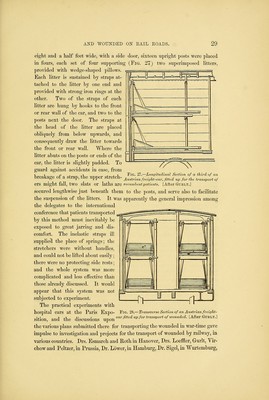
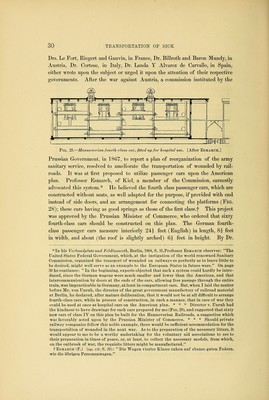
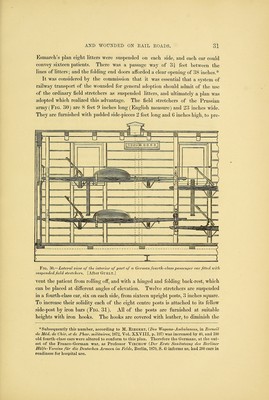
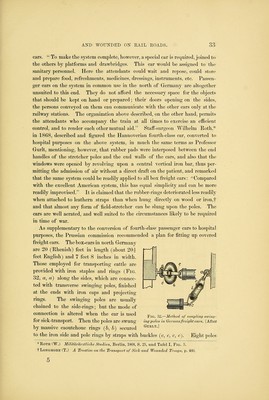
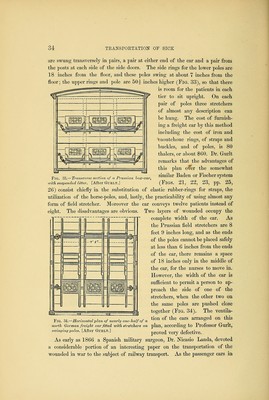
![are swung transversely in pairs, a pair at either end of the car and a pair from the posts at each side of the side doors. The side rings for the lower poles are 18 inches from the floor, and these poles swing at about 7 inches from the floor; the upper rings and pole are 50 z inches higher (Fig. 33), so that there is room for the patients in each tier to sit upright. On each pair of poles three stretchers of almost any description can be hung. The cost of furnish- ing a freight car by this method including the cost of iron and ■caoutchouc rings, of straps and buckles, and of poles, is 80 thalers, or about $60. Dr. Gurlt remarks that the advantages of this plan o%r the somewhat _ „„ ™ ,• ^ D • 7 similar Baden or Fischer system Fig. 33.—Transverse section of a Frussian box-car, •' with suspended litter. [After Guelt.] (FiGS. 21, 22, 23, pp. 25, 26) consist chiefly in the substitution of elastic rubber-rings for straps, the utilization of the horse-poles, and, lastly, the practicability of using almost any form of field stretcher. Moreover the car conveys twelve patients instead of eight. The disadvantages are obvious. Two layers of wounded occupy the complete width of the car. As the Prussian field stretchers are 8 feet 9 inches long, and as the ends of the poles cannot be placed safely at less than 6 inches from the ends of the car, there remains a space of 18 inches only in the middle of the car, for the nurses to move in. However, the width of the car is sufficient to permit a person to ap- proach the side of one of the stretchers, when the other two on the same poles are pushed close together (FiG. 34). The ventila- tion of the cars arranged on this plan, according to Professor Grurlt, proved very defective. As early as 1866 a Spanish military surgeon, Dr. Nicasio Landa, devoted a considerable portion of an interesting paper on the transportation of the wounded in war to the subject of railway transport. As the passenger cars m Fig. 34.—Horizontal plan of nearly one-half of a north German freight car fitted with stretchers on sioingingpoles. [After GuELT.]](https://iiif.wellcomecollection.org/image/b2107110x_0042.jp2/full/800%2C/0/default.jpg)

 No text description is available for this image
 No text description is available for this image
 No text description is available for this image