On the aqueous lines of the solar spectrum / by Josiah P. Cooke.
- Josiah P. Cooke
- Date:
- [1866?]
Licence: Public Domain Mark
Credit: On the aqueous lines of the solar spectrum / by Josiah P. Cooke. Source: Wellcome Collection.
Provider: This material has been provided by King’s College London. The original may be consulted at King’s College London.
1/8
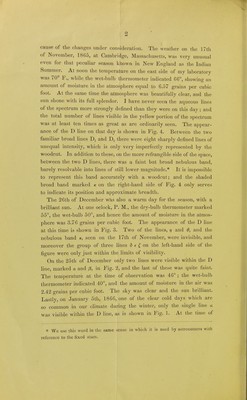
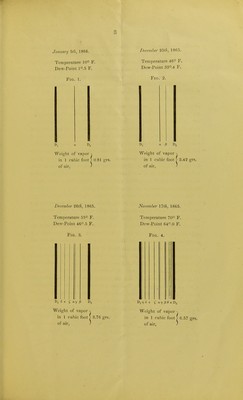
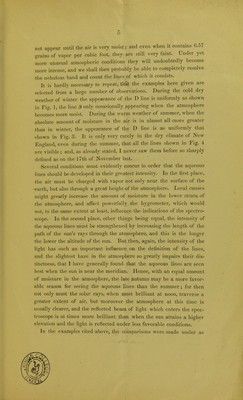
![LFitu.M THE Fkoceedinus ok thk AsiEificA.v Academy or Auts and Sciences, VoL. VII., Januauy, 186ff.] ON THE ACiUEOUS LINES OE THE SOLAR SPECTRUAI. liY JOSIAH P. COOKE, Jr. A CAREFUL examination of the solar spectrum, continued during sev- eral months with the spectro.scope described in a recent article of tlie American Journal of Science,* has led me to the conclusion that a very large number of the more faint lines of the solar spectrum, hitherto known simply as air lines, are due solely to the aqueous vapor of out- air, and hence that the absorption of the luminous solar rays by the atmosphere is at least chiefly owing to the aqueous vapor which it contains. The appearance of the Fraunhofer’s line D, seen under precisely the same conditions, but with increasing quantities of aqueous vapor in the atmosphere, is shown in Figures 1, 2, 3, and 4. The D line is selected, because being a favorite test object for the spectroscope, its general appearance is well known to all observers. But even more marked changes than those here illustrated have been noticed in other, although chiefly in contiguous, portions of the solar spectrum. These changes attracted my attention from my earliest observations with the spectroscope ; but with my first instrument, and the bisulphide of carbon prisms then employed, it was almost impossible to eliminate the effects which might be caused by the variations in the condition of the insti’ument itself; and as these were known to be very great, it was possible that they might account for all the variations observed. With the improved instrument, however, just referred to, absolute constancy of action is obtained, and all merely instrumental variations avoided. A peculiar condition of the atmosphere gave the first clew as to the * Amci'icati Journal of Science and Arts, Vol. XI., November, 18(55.](https://iiif.wellcomecollection.org/image/b21302443_0001.jp2/full/800%2C/0/default.jpg)