Remarks on antitoxin, diphtheria, the practitioner, and history : A practical view of antitoxin and diphtheria in private practice ; Antitoxin, diphtheria, and statistics / by Adolph Rupp.
- Rupp, Adolph, 1856-
- Date:
- 1899
Licence: Public Domain Mark
Credit: Remarks on antitoxin, diphtheria, the practitioner, and history : A practical view of antitoxin and diphtheria in private practice ; Antitoxin, diphtheria, and statistics / by Adolph Rupp. Source: Wellcome Collection.
Provider: This material has been provided by the National Library of Medicine (U.S.), through the Medical Heritage Library. The original may be consulted at the National Library of Medicine (U.S.)
52/58
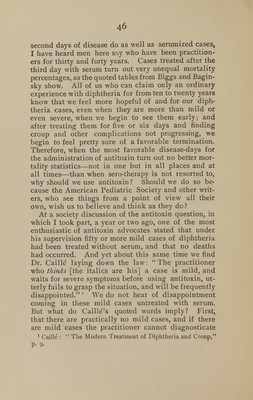
![second days of disease do as well as serumized cases, I have heard men here say who have been practition- ers for thirty and forty years. Cases treated after the third day with serum turn out very unequal mortality percentages, as the quoted tables from Biggs and Bagin- sky show. All of us who can claim only an ordinary experience with diphtheria for from ten to twenty years know that we feel more hopeful of and for our diph- theria cases, even when they are more than mild or even severe, when we begin to see them early; and after treating them for five or six days and finding croup and other complications not progressing, we begin to feel pretty sure of a favorable termination. Therefore, when the most favorable disease-days for the administration of antitoxin turn out no better mor- tality statistics—not in one but in all places and at all times—than when sero-therapy is not resorted to, why should we use antitoxin ? Should we do so be- cause the American Pediatric Society and other writ- ers, who see things from a point of view all their own, wish us to believe and think as they do? At a society discussion of the antitoxin question, in which I took part, a year or two ago, one of the most enthusiastic of antitoxin advocates stated that under his supervision fifty or more mild cases of diphtheria had been treated without serum, and that no deaths had occurred. And yet about this same time we find Dr. Caille laying down the law: The practitioner who thinks [the italics are his] a case is mild, and waits for severe symptoms before using antitoxin, ut- terly fails to grasp the situation, and will be frequently disappointed. 1 We do not hear of disappointment coming in these mild cases untreated with serum. But what do Caille's quoted words imply? First, that there are practically no mild cases, and if there are mild cases the practitioner cannot diagnosticate 1 Caille : The Modern Treatment of Diphtheria and Croup, p. Q.](https://iiif.wellcomecollection.org/image/b21151489_0052.jp2/full/800%2C/0/default.jpg)