[Report of the Medical Officer of Health for London County Council 1934].
- London County Council (London, England). County of London.
- Date:
- [1935?]
Licence: Attribution-NonCommercial 4.0 International (CC BY-NC 4.0)
Credit: [Report of the Medical Officer of Health for London County Council 1934]. Source: Wellcome Collection.
17/669 (page 11)
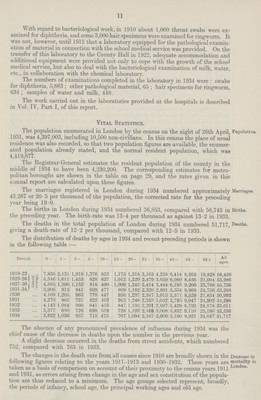
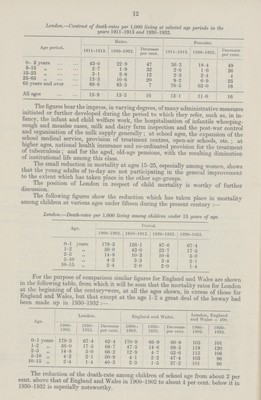
![11 With regard to bacteriological work, in 1910 about 1,000 throat swabs were ex amined for diphtheria, and some 3,000 hair specimens were examined for ringworm. It was not, however, until 1912 that a laboratory equipped for the pathological examin ation of material in connection with the school medical service was provided. On the transfer of this laboratory to the County Hall in 1922, adequate accommodation and additional equipment were provided not only to cope with the growth of the school medical service, but also to deal with the bacteriological examination of milk, water, etc., in collaboration with the chemical laboratory. The numbers of examinations completed in the laboratory in 1934. were: swabs for diphtheria, 5,883; other pathological material, 65; hair specimens for ringworm, 634; samples of water and milk, 448. The work carried out in the laboratories provided at the hospitals is described in Vol. IV, Part I, of this report. Population. Vital Statistics. The population enumerated in London by the census on the night of 26th April, 1931, was 4,397,003, including 10,500 non-civilians. In this census the place of usual residence was also recorded, so that two population figures are available, the enumer ated population already stated, and the normal resident population, which was 4,419,877. The Registrar-General estimates the resident population of the county in the middle of 1934 to have been 4,230,200. The corresponding estimates for metro politan boroughs are shown in the table on page 29, and the rates given in this annual report are calculated upon these figures. Marriages. The marriages registered in London during 1934 numbered approximately 43,267 or 20.5 per thousand of the population, the corrected rate for the preceding vear being 19.0. Births. The births in London during 1934 numbered 56,853, compared with 56,743 in the preceding year. The birth-rate was 13.4 per thousand as against 13.2 in 1933. Deaths. The deaths in the total population of London during 1934 numbered 51,717, giving a death-rate of 12.2 per thousand, compared with 12.5 in 1933. The distribution of deaths by ages in 1934 and recent preceding periods is shown in the following table:— Period. 0- 1- 2- 5- 10- 15- 20- 25- 35- 45- 55- 65+ All ages. 1919-22 Annual average. 7,836 2,131 1,919 1,376 853 1,175 1,318 3,103 4,238 6,414 8,265 19,828 58,456 1923-26 5,546 1,611 1,453 828 637 1,013 1,220 2,479 3,659 6,080 8,456 21,004 53,986 ]927-30 4,585 1,396 1,152 818 490 1,009 1,245 2,414 3,444 6,195 9,200 23,788 55,736 1931-34 3,906 915 841 669 477 809 1,182 2,320 2,891 5,554 8,968 24,756 53,288 1930 4,109 1,205 963 779 447 956 1,237 2,347 3,015 5,571 8,529 21,834 50,992 1931 4,270 862 721 622 463 953 1,248 2,353 3,052 5,795 9,047 24,902 54,288 1932 4,143 1,084 960 641 453 847 1,195 2,291 2,897 5,429 8,793 24,878 53,611 1933 3,377 630 728 698 518 728 1,193 2,168 3,008 5,832 9,110 25,196 53,536 1934 3,832 1,036 957 715 475 707 1,094 2,167 2,606 5,160 8,921 24,047 51,717 The absence of any pronounced prevalence of influenza during 1934 was the chief cause of the decrease in deaths upon the number in the previous year. A slight decrease occurred in the deaths from street accidents, which numbered 752, compared with 763 in 1933. Decrease in mortality in London. The changes in the death-rate from all causes since 1910 are broadly shown in the following figures relating to the years 1911-1913 and 1930-1932. These years are taken as a basis of comparison on account of their proximity to the census years 1911 and 1931, as errors arising from change in the age and sex constitution of the popula tion are thus reduced to a minimum. The age groups selected represent, broadly, the periods of infancy, school age, the principal working ages and old age.](https://iiif.wellcomecollection.org/image/b18252813_0017.jp2/full/800%2C/0/default.jpg)