The diseases of infancy and childhood : for the use of students and practitioners of medicine / by L. Emmett Holt and John Howland.
- Luther Emmett Holt
- Date:
- 1911
Licence: Public Domain Mark
Credit: The diseases of infancy and childhood : for the use of students and practitioners of medicine / by L. Emmett Holt and John Howland. Source: Wellcome Collection.
Provider: This material has been provided by the Augustus C. Long Health Sciences Library at Columbia University and Columbia University Libraries/Information Services, through the Medical Heritage Library. The original may be consulted at the the Augustus C. Long Health Sciences Library at Columbia University and Columbia University.
1147/1178 page 1085
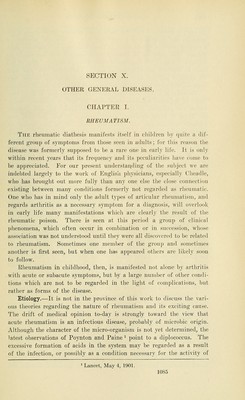
![SECTION X. OTHER GENERAL DISEASES. CHAPTER I. RHEUMATISM. The rheumatic diathesis manifests itself in ciiildren ]jy quite a dif- ferent group of symptoms from those seen in adults; for this reason the disease was formerly supposed to be a rare one in early life. It is only within recent years that its frequency and its peculiarities have come to be appreciated. For our present understan,ding of the subject we are indebted largely to the work of English physicians, especially Cheadle, who has brought out more fully than any one else the close connection existing between many conditions formerly not regarded as rheumatic. One who has in mind only the adult types of articular rheumatism, and regards arthritis as a necessary symptom for a diagnosis, will overlook in early life many manifestations which are clearly tlie result of the rheumatic poison. There is seen at this period a group of clinical phenomena, which often occur in combination or in succession, whose association was not understood until they were all discovered to be related to rheumatism. Sometimes one member of the group and sometimes another is first seen, but when one has appeared others are likely soon to follow. Eheumatism in childhood, then, is manifested not alone by arthritis with acute or subacute symptoms, but by a large number of other condi- tions which are not to be regarded in the light of complications, but rather as forms of the disease. Etiology.—It is not in the province of this work to discuss the vari- ous theories regarding the nature of rheumatism and its exciting cause. The drift of medical opinion to-day is strongly toward the view that acute rheumatism is an infectious disease, probably of microbic origin. Although the character of the micro-organism is not yet determined, the latest observations of Poynton and Paine ^ point to a diplococcus. The excessive formation of acids in the system may be regarded as a result of the infection, or possibly as a condition necessary for the activity of * Lancet, May 4, 190L](https://iiif.wellcomecollection.org/image/b21218407_1147.jp2/full/800%2C/0/default.jpg)