Licence: Public Domain Mark
Credit: Hygiene / by J. Lane Notter and R.H. Firth. Source: Wellcome Collection.
Provider: This material has been provided by The University of Leeds Library. The original may be consulted at The University of Leeds Library.
117/454 page 101
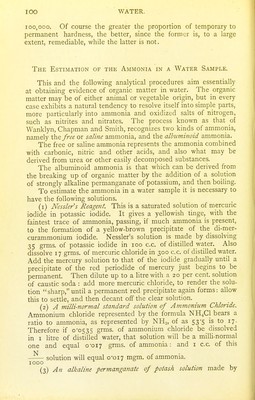
![WATER A-Nki^'lsV ^ ^ ^ ' '' lOI dissolving 200 grms. of cau§tfc''^p6yiJtf <«]M*^§'|i4^. ^I^^i^tfeslitim permanganate in iioo c.c. of distilled water, and then rapidly boiling the solution down to i litre or 1000 cc. To determine the Free Ammonia, place 250 c.c. of the water sample in a retort and connect with a condenser. Apply heat to the retort and rapidly distil over the retort contents, catching the distillate in a Nessler's glass. As a rule the whole of the free ammonia will pass over in 130 to 140 c.c. of distillate, but before stopping the distillation a drop or two of the distillate should be received into a test-tube, one drop of Nessler's reagent added and note taken whether the yellow-brown tinge due to the presence of ammonia is given. If Nessler's reagent indicates that no more ammonia is coming over, the light may be put out and distillation stopped, but if ammonia be still coming over the distillation must be continued until it ceases to do so. ' The whole of the ammonia having come over, the total amount of the distillate must be measured and recorded Next take some of the distillate in a test-tube, add one drop of Nessler's reagent ; if the resulting colour be very dark, it indicates much ammonia; if light, less of it. If the colour be not very deep 100 cc. of the distillate must be placed in a Nessler glass, and to them added 1-5 cc of Nessler's solution; on stirring and allowing to stand for a short time a yellow to brown tint will be tound. This colour is caused by the presence of ammonia, the precise amount of which we proceed to estimate in the following S-''^^; ^° ^dded varying quantitiel of the standard ammonmm chloride solution, each made up to ''T^ a- ^'^^'^^^^ ^^^^ ^5 cc. of Nessler's reagent added. When a tint exactly corresponding with that given bv the 100 cc of the water sample in the presence of A c.c. of Nessler s solution has been obtained, the quantity of standard ammoniuni chloride solution added is read off. This procedure of noting and comparing tints as given by different amounts of ammonia with Nessler's reagent is called Nesslerizing buppose, for example, from 250 c.c of water placed in the retort, 140 c^. have been distilled over before all the ammonia came over. On testing a little of this distillate with some Nessler's reagent, a very deep colour was given. 10 c.c of the distillate ta. ^ A ^ ^^'''^^ S^^'^' ™^de up to 100 cc with distilled water and 1-5 cc of Nessler's solution added. In a similar glass, 5 cc. of the standard ammonium chloride solution after being made up to 100 with distilled water, and treated with cc of Nessler s reagent are found to give the same yellow tinge. Then hloride'-sdutionHh'?'f' ^'^^ ' ^'^ °^ cnioride solution, the whole 140 cc of the distillate representing](https://iiif.wellcomecollection.org/image/b21509979_0117.jp2/full/800%2C/0/default.jpg)