The abnormal behaviour of glyoxaline-carboxlic esters and anilides towards diazonium salts / by Robert George Fargher and Frank Lee Pyman.
- Fargher, Robert George.
- Date:
- 1919.]
Licence: Public Domain Mark
Credit: The abnormal behaviour of glyoxaline-carboxlic esters and anilides towards diazonium salts / by Robert George Fargher and Frank Lee Pyman. Source: Wellcome Collection.
2/6 (page 1016)
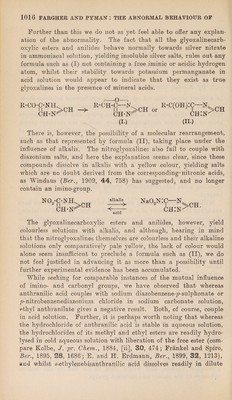
![Further than this we do not as yet feel able to offer any explan¬ ation of the abnormality. The fact that all the glyoxalinecarb- oxylic esters and anilides behave normally towards silver nitrate in ammoniacal solution, yielding insoluble silver salts, rules out any formula such as (I) not containing a free iminic or acidic hydrogen atom, whilst their stability towards potassium permanganate in acid solution would appear to indicate that they exist as true glyoxalines in the presence of mineral acids. R-C'OC-NH CH*lSr 0— R-OH-C—N CH-N^C (I.) or R-C(°H):C-N ch:isk (id There is, however, the possibility of a molecular rearrangement, such as that represented by formula (II), taking place under the influence of alkalis. The nitroglyoxalines also fail to couple with diazonium salts, and here the explanation seems clear, since these compounds dissolve in alkalis with a yellow .colour, yielding salts which are no doubt derived from the corresponding* nitronic acids, as Windaus (Ber., 1909, 44, 758) has suggested, and no longer contain an imino-group. alkalilL Na02NI ^- acid The glyoxalinecarboxylic esters and anilides, however, yield colourless solutions with alkalis, and although, bearing in mind that the nitroglyoxalines themselves are colourless and their alkaline solutions only comparatively pale yellow, tli6 lack of colour would alone seem insufficient to preclude a formula such as (II), we do not feel justified in advancing it as more than a possibility until further experimental evidence has been accumulated. While seeking for comparable instances of the mutual influence of imino- and carbonyl groups, we have observed that whereas anthranilic acid couples with sodium diazobenzene-£>-sulphonate or p-nitrobenzenediazonium chloride in sodium carbonate solution, ethyl anthranilate gives a negative result. Roth, of course, couple in acid solution. Further, it is perhaps worth noting that whereas the hydrochloride of anthranilic acid is stable in aqueous solution, the hydrochlorides of its methyl and ethyl esters are readily hydro¬ lysed in cold aqueous solution with liberation of the free ester (com¬ pare Kolbe, J. pr. Chem., 1884, [ii], 30, 474; Frankel and Spiro, Ber., 1895, 28, 1686; E. and H. Erdmann, Ber., 1899, 32, 1213), and whilst ^ethyleiiebisanthranilic acid dissolves readily in dilute C—N ch:n >ch. no’Fnh>ch CH-1SW](https://iiif.wellcomecollection.org/image/b30622190_0002.jp2/full/800%2C/0/default.jpg)