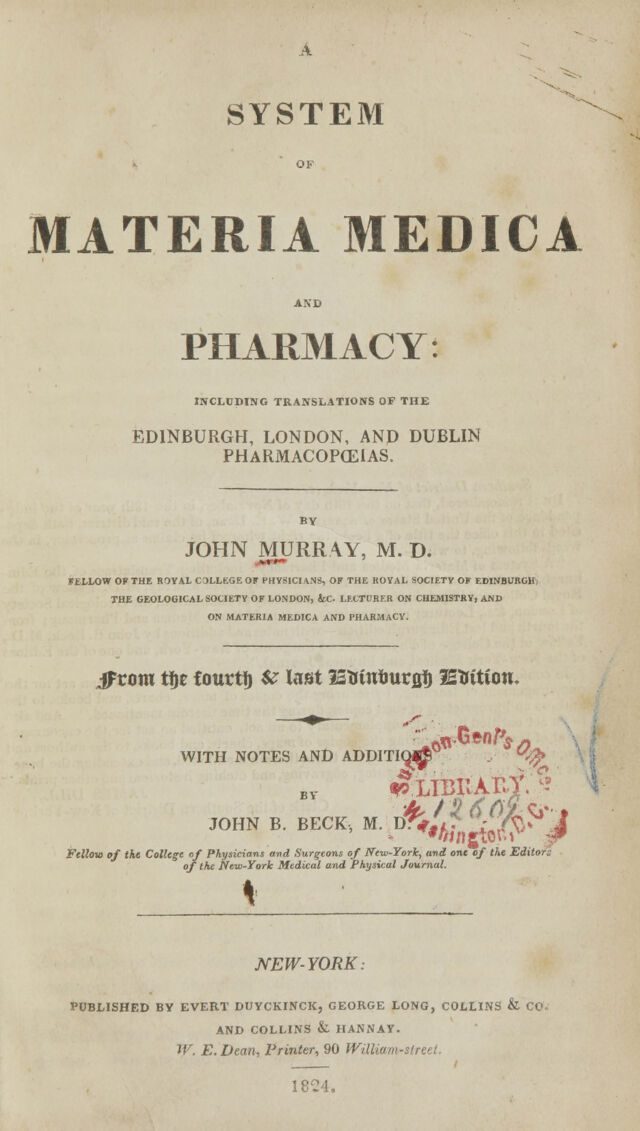
A system of materia medica and pharmacy : including translations of the Edinburgh, London, and Dublin pharmacopoeias / by John Murray.
- John Murray
- Date:
- 1824
Licence: Public Domain Mark
Credit: A system of materia medica and pharmacy : including translations of the Edinburgh, London, and Dublin pharmacopoeias / by John Murray. Source: Wellcome Collection.
Provider: This material has been provided by the National Library of Medicine (U.S.), through the Medical Heritage Library. The original may be consulted at the National Library of Medicine (U.S.)
77/572
![this case. The tact speaks for itself. The turpentine must be taken in- to the circulation, and afterwards act directly upon the urinary organs or else the violet odour could not be detected in the urine. Here, then is at least one clear and pointed exception to Dr. Chapman's theory. Let us take another illustration. In discussing the general action of Lithontnptics and Antilithies, it is stated that the possibility of dissolving a stone in the bladder by a course of medicine rests upon two rounds one ot which is the following, viz. « that some of these solvents do reach the urinary bladder, without any, or, at least, a material change being wrought in their properties, so that when coming in contact with the stone, there might be a play of chemical affinities, and hence a decomposition of the cal- culous body.'-vol. i. p. 322. Now, here is an unqualified admission, of not a single medicine, but a whole class of medicines acting upon principles purely chemical. In so far, therefore, as this class of remedies is concern- ed, it cuts short the doctrine of sympathy, and proves beyond a doubt, that the unlimited manner in which that doctrine is maintained by Dr.' Chapman is wholly untenable. No sympathetic actions, nor associat- ed motions, nor radiated impressions diffused from a point, can ever dissolve a stone in the bladder, or account for the varied appearance of the urine, resulting from the use of internal remedies. Another exception to Dr. Chapman's theory may be found in the list of Anthelmintic medicines, a large portion of which are admitted to act by their poisonous properties upon the animal. But it is unnecessary to push this subject any further. Enough has been adduced to prove, that the doc- trine of sympathy can only be admitted with such large qualifications and exceptions, as to overturn completely the theory that medicines uniform- ly and Universally act upon this principle alone. 1 hope not to be misun- derstood, in explaining the operation of medicines I do by no means deny altogether the agency of sympathy, or some principle very similar to it. To contend, that all medicines act through the medium of the cir- culation would be not Less contradictory to re .son and fact, than the doc- trine which has been combatted. I do not believe in this wonderful simpli- city of nature, which has been so favourite an argument with every the- orist who has attempted to explain the intricacies of a whole science upon one general principle. Dr. Chapman, for instance, tells us, that to mul- tiply causes superfluously is against one of the fundamental rules of phi- losophising, and is not less repugnant to the general course of nature, whose means are proverbially distinguished by great simplicity and uni- formity. Tins is true indeed ; but then it is equally unphilosophical, not to assign causes sufficient to ex] iwn and acknowledged pheno- mena ; and as it regards the present ca le, it rests with Dr. Chapman to show that by calling in the aid of the circulation we multiply causes un- necessarily. An excessive fondness or simplification has been the bane of medical science. It*was this which led Brown to maintain the absurd doctrine that all medicines were stimulants, the only-difierence between them being in the force and rapidity with which they exercised their stimu- lating powers. It was this which prompted Dr. Rush to defend the strange. notion of the unity of disease, and it is this which induces Dr. Chapman to contend for the exclusii e a dry, in explaining the opera- tions of medicines. Wanting, as they all do, the broad and substantial bas- is o£ truth and philosophy upon which to rest, it is impossible that their influence should he other than transient and ephemeral. The theory of Brown has long since been abandoned. The unity of disease, notwilk-](https://iiif.wellcomecollection.org/image/b21143201_0077.jp2/full/800%2C/0/default.jpg)
 No text description is available for this image
 No text description is available for this image
 No text description is available for this image