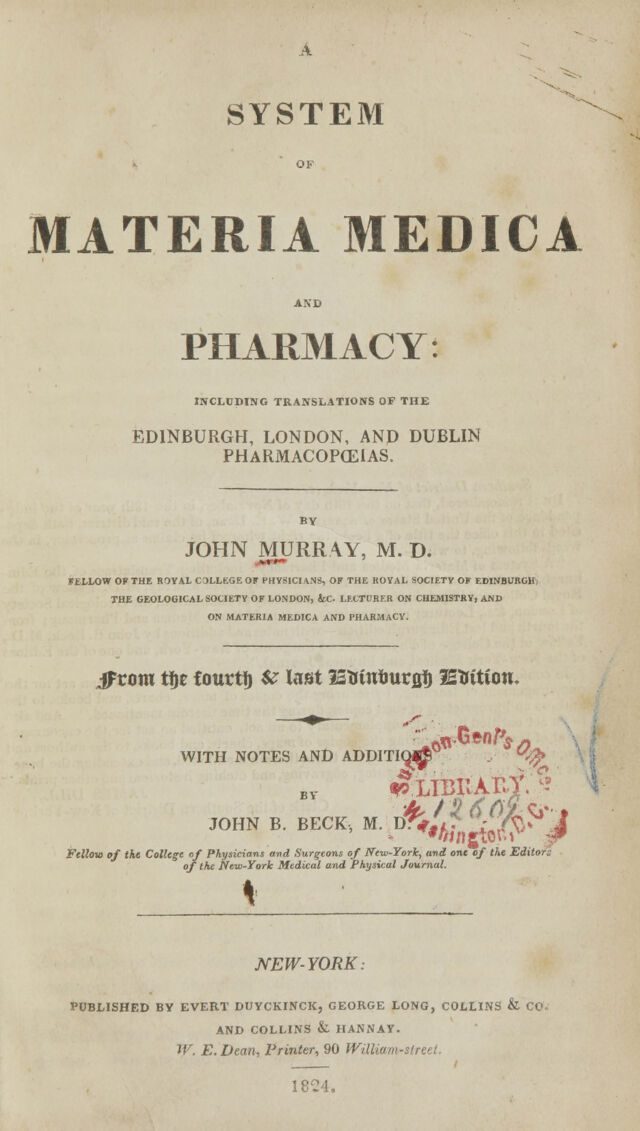
A system of materia medica and pharmacy : including translations of the Edinburgh, London, and Dublin pharmacopoeias / by John Murray.
- John Murray
- Date:
- 1824
Licence: Public Domain Mark
Credit: A system of materia medica and pharmacy : including translations of the Edinburgh, London, and Dublin pharmacopoeias / by John Murray. Source: Wellcome Collection.
Provider: This material has been provided by the National Library of Medicine (U.S.), through the Medical Heritage Library. The original may be consulted at the National Library of Medicine (U.S.)
78/572
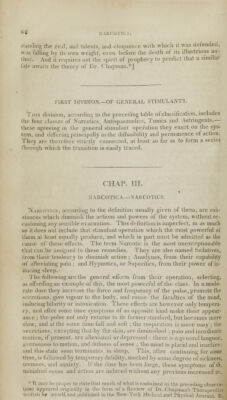
![t;<* KARC03 ling the zeal, and talents, and eloquence with which it was defended, was falling by its own weight, even before the death of its illustrious au- thor. And it requires not the spirit of prophecy to predict that a similar late awaits the theory of Dr. Chapman.*] FIRST DIVISION.—OF GENERAL STIMULANTS. This division, according to the preceding table of classification, includes the four classes of Narcotics, Antispasmodics, Tonics and Astringents,— these agreeing in the general stimulant operation they exert on the sys- tem, and differing principally in the diffusibility and permanence of action. They are therefore strictly connected, at least so far as to form a series through which the transition is easily traced. CHAP. III. NARCQTICA.—NARCOTICS. Narcotics, according to the definition usually given of them, are sub- stances which diminish the actions and powers of the system, without oc- casioning any sensible evacuation. This definition is imperfect, in as much as it does not include that stimulant operation which the most powerful of them at least equally produce, and which in part must be admitted as the cause of these effects. The term Narcotic is the most unexceptionable that can be assigned to these remedies. They are also named Sedatives, from their tendency to diminish action ; Anodynes, from their capability of alleviating pain ; and Hypnotics, or Soporifics, from their power of in- ducing sleep. The following are the general effects from their operation, selecting, as affording an example of this, the most powerful of the class. In a mode- rate dose they increase the force and frequency of the pulse, promote the secretions, give vigour to the body, and rouse the faculties of the mind, inducing hilarity or intoxication. These effects arc however only tempora- ry, and after some time symptoms of an opposite kind make their appear- ance ; the pulse not only returns to its former standard, but becomes more slow, and at the same time full and soft ; the respiration is more easy ; the secretions, excepting that by the skin, are diminished ; pain and inordinate motion, if present, are alleviated or depressed : there is a general languor, avcrseness to motion, and dulness of sense ; the mind is placid and inactive; and this state soon terminates in sleep. This, after continuing for some time, is followed by temporary debility, marked by some degree of sickness, tremors, and anxiety. If the dose has been large, these symptoms of di- minished sense and action are induced without any previous increased ac. maybe proper to state that much of what is contained in the preceding obierva- tioas appeared originally in the form of a Review of Dr. Chapman's Therapeutics written bp myself, and published in the New-York Medical and Physical Journal. B.](https://iiif.wellcomecollection.org/image/b21143201_0078.jp2/full/800%2C/0/default.jpg)